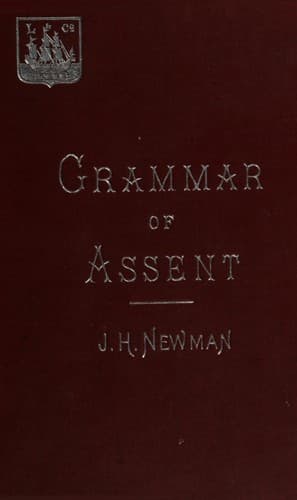
An Essay in Aid of a Grammar of AssentNewman, John Henry
Religion
An Essay in Aid of a Grammar of Assent
Newman, John Henry
Faith; Theism
I believe the best editors of the Greek tragedians have given up the
impertinence of introducing their conjectures into the text; and a
classic like Shakespeare has a right to be treated with the same
respect as Æschylus. To this it will be replied, that Shakespeare is
for the general public and Æschylus for students of a dead language;
that the run of men read for amusement or as a recreation, and that,
if the editions of Shakespeare were made on critical principles, they
would remain unsold. Here, then, we are brought to the question whether
it is any advantage to read Shakespeare except with the care and pains
which a classic demands, and whether he is in fact read at all by those
whom such critical exactness would offend; and thus we are led on to
further questions about cultivation of mind and the education of the
masses. Further, the question presents itself, whether the general
admiration of Shakespeare is genuine, whether it is not a mere fashion,
whether the multitude of men understand him at all, whether it is not
true that every one makes much of him, because every one else makes
much of him. Can we possibly make Shakespeare light reading, especially
in this day of cheap novels, by ever so much correction of his text?
Now supposing this point settled, and the text of 1623 put out of
court, then comes the claim of the Annotator to introduce into
Shakespeare’s text the emendation made upon his copy of the edition of
1632; why is he not of greater authority than Theobald, the inventor
of the received reading, and his emendation of more authority than
Theobald’s? If the corrupt reading must any how be got out of the
way, why should not the Annotator, rather than Theobald, determine
its substitute? For what we know, the authority of the anonymous
Annotator may be very great. There is nothing to show that he was
not a contemporary of the poet; and if so, the question arises, what
is the character of his emendations? are they his own private and
arbitrary conjectures, or are they informations from those who knew
Shakespeare, traditions of the theatre, of the actors or spectators of
his plays? Here, then, we are involved in intricate questions which
can only be decided by a minute examination of the 20,000 emendations
so industriously brought together by this anonymous critic. But
it is obvious that a verbal argumentation upon 20,000 corrections
is impossible: there must be first careful processes of perusal,
classification, discrimination, selection, which mainly are acts of the
mind without the intervention of language. There must be a cumulation
of arguments on one side and on the other, of which only the heads or
the results can be put upon paper. Next come in questions of criticism
and taste, with their recondite and disputable premisses, and the
usual deductions from them, so subtle and difficult to follow. All
this being considered, am I wrong in saying that, though controversy
Public-domain text, read in full here on John Shaqi.
Reviews
Reviews
No reviews yet
Be the first to share your thoughts on this work.
Elsewhere in the archive
Join the Discussion
Join the discussion
Sign in to leave a comment or review.
Sign InorCreate an account