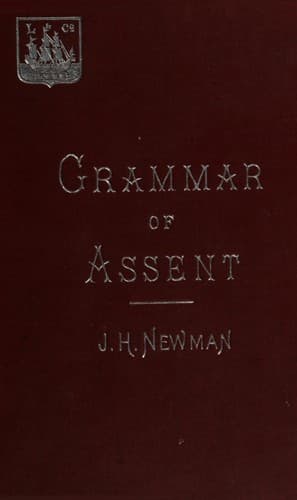
An Essay in Aid of a Grammar of AssentNewman, John Henry
Religion
An Essay in Aid of a Grammar of Assent
Newman, John Henry
Faith; Theism
Nor is it any disparagement of the proper value of formal reasonings
thus to speak of them. That they cannot proceed beyond probabilities
is most readily allowed by those who use them most. Philosophers,
experimentalists, lawyers, in their several ways, have commonly the
reputation of being, at least on moral and religious subjects, hard
of belief; because, proceeding in the necessary investigation by the
analytical method of verbal inference, they find within its limits
no sufficient resources for attaining a conclusion. Nay, they do not
always find it possible in their own special province severally; for,
even when in their hearts they have no doubt about a conclusion, still
often, from the habit of their minds, they are reluctant to own it,
and dwell upon the deficiencies of the evidence, or the possibility of
error, because they speak by rule and by book, though they judge and
determine by common-sense.
Every exercise of nature or of art is good in its place; and the uses
of this logical inference are manifold. It is the great principle of
order in our thinking; it reduces a chaos into harmony; it catalogues
the accumulations of knowledge; it maps out for us the relations of
its separate departments; it puts us in the way to correct its own
mistakes. It enables the independent intellects of many, acting and
re-acting on each other, to bring their collective force to bear upon
one and the same subject-matter, or the same question. If language
is an inestimable gift to man, the logical faculty prepares it for
our use. Though it does not go so far as to ascertain truth, still it
teaches us the direction in which truth lies, and how propositions
lie towards each other. Nor is it a slight benefit to know what is
probable, and what is not so, what is needed for the proof of a point,
what is wanting in a theory, how a theory hangs together, and what
will follow, if it be admitted. Though it does not itself discover
the unknown, it is one principal way by which discoveries are made.
Moreover, a course of argument, which is simply conditional, will
point out when and where experiment and observation should be applied,
or testimony sought for, as often happens both in physical and legal
questions. A logical hypothesis is the means of holding facts together,
explaining difficulties, and reconciling the imagination to what is
strange. And, again, processes of logic are useful as enabling us to
get over particular stages of an investigation speedily and surely, as
on a journey we now and then gain time by travelling by night, make
short cuts when the high-road winds, or adopt water-carriage to avoid
fatigue.
Public-domain text, read in full here on John Shaqi.
Reviews
Reviews
No reviews yet
Be the first to share your thoughts on this work.
Elsewhere in the archive
Join the Discussion
Join the discussion
Sign in to leave a comment or review.
Sign InorCreate an account