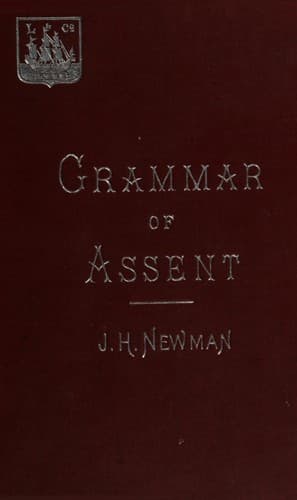
An Essay in Aid of a Grammar of AssentNewman, John Henry
Religion
An Essay in Aid of a Grammar of Assent
Newman, John Henry
Faith; Theism
But reasoning by rule and in words is too natural to us, to admit
of being regarded merely in the light of utility. Our inquiries
spontaneously fall into scientific sequence, and we think in logic,
as we talk in prose, without aiming at doing so. However sure we are
of the accuracy of our instinctive conclusions, we as instinctively
put them into words, as far as we can; as preferring, if possible, to
have them in an objective shape which we can fall back upon,—first
for our own satisfaction, then for our justification with others.
Such a tangible defence of what we hold, inadequate as it necessarily
is, considered as an analysis of our ratiocination in its length and
breadth, nevertheless is in such sense associated with our holdings,
and so fortifies and illustrates them, that it acts as a vivid
apprehension acts, giving them luminousness and force. Thus inference
becomes a sort of symbol of assent, and even bears upon action.
I have enlarged on these obvious considerations, lest I should seem
paradoxical; but they do not impair the main position of this Section,
that Inference, considered in the shape of verbal argumentation,
determines neither our principles, nor our ultimate judgments,—that it
is neither the test of truth, nor the adequate basis of assent.(12)
§ 2. Informal Inference.
It is plain that formal logical sequence is not in fact the method
by which we are enabled to become certain of what is concrete; and
it is equally plain, from what has been already suggested, what the
real and necessary method is. It is the cumulation of probabilities,
independent of each other, arising out of the nature and circumstances
of the particular case which is under review; probabilities too fine
to avail separately, too subtle and circuitous to be convertible into
syllogisms, too numerous and various for such conversion, even were
they convertible. As a man’s portrait differs from a sketch of him, in
having, not merely a continuous outline, but all its details filled in,
and shades and colours laid on and harmonized together, such is the
multiform and intricate process of ratiocination, necessary for our
reaching him as a concrete fact, compared with the rude operation of
syllogistic treatment.
Public-domain text, read in full here on John Shaqi.
Reviews
Reviews
No reviews yet
Be the first to share your thoughts on this work.
Elsewhere in the archive
Join the Discussion
Join the discussion
Sign in to leave a comment or review.
Sign InorCreate an account