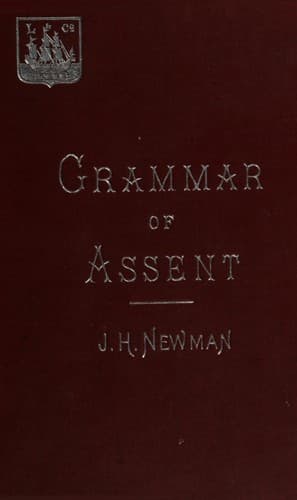
An Essay in Aid of a Grammar of AssentNewman, John Henry
Religion
An Essay in Aid of a Grammar of Assent
Newman, John Henry
Faith; Theism
It is this distinction between ratiocination as the exercise of
a living faculty in the individual intellect, and mere skill in
argumentative science, which is the true interpretation of the
prejudice which exists against logic in the popular mind, and of the
animadversions which are levelled against it, as that its formulas make
a pedant and a _doctrinaire_, that it never makes converts, that it
leads to rationalism, that Englishmen are too practical to be logical,
that an ounce of common-sense goes farther than many cartloads of
logic, that Laputa is the land of logicians, and the like. Such maxims
mean, when analyzed, that the processes of reasoning which legitimately
lead to assent, to action, to certitude, are in fact too multiform,
subtle, omnigenous, too implicit, to allow of being measured by rule,
that they are after all personal,—verbal argumentation being useful
only in subordination to a higher logic. It is this which was meant
by the Judge who, when asked for his advice by a friend, on his being
called to important duties which were new to him, bade him always lay
down the law boldly, but never give his reasons, for his decision was
likely to be right, but his reasons sure to be unsatisfactory. This is
the point which I proceed to illustrate.
1. I will take a question of the present moment. “We shall have a
European war, _for_ Greece is audaciously defying Turkey.” How are we
to test the validity of the reason, implied, not expressed, in the
word “for”? Only the judgment of diplomatists, statesmen, capitalists,
and the like, founded on experience, strengthened by practical and
historical knowledge, controlled by self-interest, can decide the worth
of that “for” in relation to accepting or not accepting the conclusion
which depends on it. The argument is from concrete fact to concrete
fact. How will mere logical inferences, which cannot proceed without
general and abstract propositions, help us on to the determination
of this particular case? It is not the case of Switzerland attacking
Austria, or of Portugal attacking Spain, or of Belgium attacking
Prussia, but a case without parallels. To draw a scientific conclusion,
the argument must run somewhat in this way:—“All audacious defiances
of Turkey on the part of Greece must end in a European war; these
present acts of Greece are such: ergo;”—where the major premiss is
more difficult to accept than the conclusion, and the proof becomes an
“obscurum per obscurius.” But, in truth, I should not betake myself
to some one universal proposition to defend my view of the matter; I
should determine the particular case by its particular circumstances,
by the combination of many uncatalogued experiences floating in my
memory, of many reflections, variously produced, felt rather than
capable of statement; and if I had them not, I should go to those who
had. I assent in consequence of some such complex act of judgment,
or from faith in those who are capable of making it, and practically
Public-domain text, read in full here on John Shaqi.
Reviews
Reviews
No reviews yet
Be the first to share your thoughts on this work.
Elsewhere in the archive
Join the Discussion
Join the discussion
Sign in to leave a comment or review.
Sign InorCreate an account