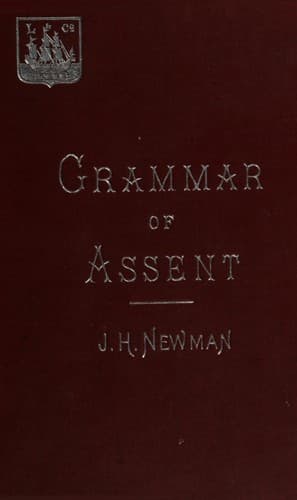
An Essay in Aid of a Grammar of AssentNewman, John Henry
Religion
An Essay in Aid of a Grammar of Assent
Newman, John Henry
Faith; Theism
Here are two celebrated writers in direct opposition to each other in
their fundamental view of truth and duty. Shall we say that there is
no such thing as truth and error, but that anything is truth to a man
which he troweth? and not rather, as the solution of a great mystery,
that truth there is, and attainable it is, but that its rays stream in
upon us through the medium of our moral as well as our intellectual
being; and that in consequence that perception of its first principles
which is natural to us is enfeebled, obstructed, perverted, by
allurements of sense and the supremacy of self, and, on the other hand,
quickened by aspirations after the supernatural; so that at length two
characters of mind are brought out into shape, and two standards and
systems of thought,—each logical, when analyzed, yet contradictory
of each other, and only not antagonistic because they have no common
ground on which they can conflict?
6. Montaigne was endowed with a good estate, health, leisure, and an
easy temper, literary tastes, and a sufficiency of books: he could
afford thus to play with life, and the abysses into which it leads us.
Let us take a case in contrast.
“I think,” says the poor dying factory-girl in the tale, “if this
should be the end of all, and if all I have been born for is just to
work my heart and life away, and to sicken in this dree place, with
those mill-stones in my ears for ever, until I could scream out for
them to stop and let me have a little piece of quiet, and with the
fluff filling my lungs, until I thirst to death for one long deep
breath of the clear air, and my mother gone, and I never able to tell
her again how I loved her, and of all my troubles,—I think, if this
life is the end, and that there is no God to wipe away all tears from
all eyes, I could go mad!(17)”
Here is an argument for the immortality of the soul. As to its force,
be it great or small, will it make a figure in a logical disputation,
carried on _secundum artem_? Can any scientific common measure compel
the intellects of Dives and Lazarus to take the same estimate of it? Is
there any test of the validity of it better than the _ipse dixit_ of
private judgment, that is, the judgment of those who have a right to
judge, and next, the agreement of many private judgments in one and the
same view of it?
Public-domain text, read in full here on John Shaqi.
Reviews
Reviews
No reviews yet
Be the first to share your thoughts on this work.
Elsewhere in the archive
Join the Discussion
Join the discussion
Sign in to leave a comment or review.
Sign InorCreate an account