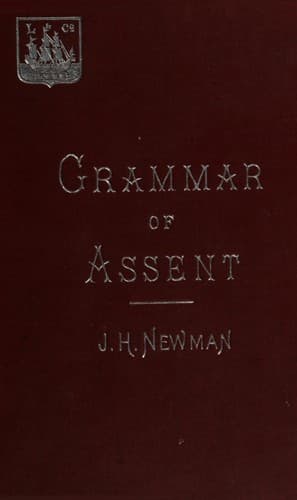
An Essay in Aid of a Grammar of AssentNewman, John Henry
Religion
An Essay in Aid of a Grammar of Assent
Newman, John Henry
Faith; Theism
It may be added, that, whereas the logical form of this argument,
is, as I have already observed, indirect, viz. that “the conclusion
cannot be otherwise,” and Butler says that an event is proved, if
its antecedents “could not in reason be supposed to have happened
_unless_ it were true,” and law-books tell us that the principle of
circumstantial evidence is the _reductio ad absurdum_, so Newton
is forced to the same mode of proof for the establishment of his
lemma, about prime and ultimate ratios. “If you deny that they become
ultimately equal,” he says, “let them be ultimately unequal;” and the
consequence follows, “which is against the supposition.”
Such being the character of the mental process in concrete reasoning,
I should wish to adduce some good instances of it in illustration,
instances in which the person reasoning confesses that he is reasoning
on this very process, as I have been stating it; but these are
difficult to find, from the very circumstance that the process from
first to last is carried on as much without words as with them.
However, I will set down three such.
1. First, an instance in physics. Wood, treating of the laws of motion,
thus describes the line of reasoning by which the mind is certified of
them. “They are not indeed self-evident, nor do they admit of accurate
proof by experiment, on account of the effects of friction and the
air’s resistance, which cannot entirely be removed. They are, however,
constantly and invariably suggested to our senses, and they agree with
experiment, as far as experiment can go; and the more accurately the
experiments are made, and the greater care we take to remove all those
impediments which tend to render the conclusions erroneous, the more
nearly do the experiments coincide with these laws.
“Their truth is also established upon a different ground: from these
general principles innumerable particular conclusions have been
deducted; sometimes the deductions are simple and immediate, sometimes
they are made by tedious and intricate operations; yet they are all,
without exception, consistent with each other and with experiment. It
follows thereby, that the principles upon which the calculations are
founded are true.(23)”
Public-domain text, read in full here on John Shaqi.
Reviews
Reviews
No reviews yet
Be the first to share your thoughts on this work.
Elsewhere in the archive
Join the Discussion
Join the discussion
Sign in to leave a comment or review.
Sign InorCreate an account