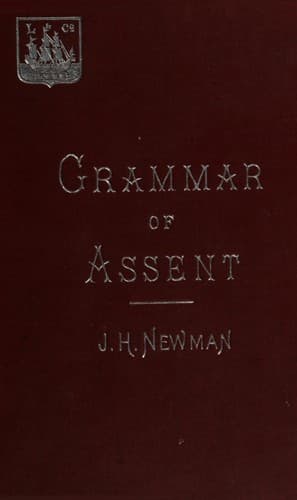
An Essay in Aid of a Grammar of AssentNewman, John Henry
Religion
An Essay in Aid of a Grammar of Assent
Newman, John Henry
Faith; Theism
My object in the foregoing pages has been, not to form a theory which
may account for those phenomena of the intellect of which they treat,
viz. those which characterize inference and assent, but to ascertain
what is the matter of fact as regards them, that is, when it is that
assent is given to propositions which are inferred, and under what
circumstances. I have never had the thought of an attempt which would
be ambitious in me, and which has failed in the hands of others, if
that attempt may not unfairly be called unsuccessful, which, though
made by the acutest minds, has not succeeded in convincing opponents.
Especially have I found myself unequal to antecedent reasonings in
the instance of a matter of fact. There are those, who, arguing _à
priori_, maintain, that, since experience leads by syllogism only to
probabilities, certitude is ever a mistake. There are others, who,
while they deny this conclusion, grant the _à priori_ principle assumed
in the argument, and in consequence are obliged, in order to vindicate
the certainty of our knowledge, to have recourse to the hypothesis of
intuitions, intellectual forms, and the like, which belong to us by
nature, and may be considered to elevate our experience into something
more than it is in itself. Earnestly maintaining, as I would, with this
latter school of philosophers, the certainty of knowledge, I think it
enough to appeal to the common voice of mankind in proof of it. That is
to be accounted a normal operation of our nature, which men in general
do actually instance. That is a law of our minds, which is exemplified
in action on a large scale, whether _à priori_ it ought to be a law or
no. Our hoping is a proof that hope, as such, is not an extravagance;
and our possession of certitude is a proof that it is not a weakness or
an absurdity to be certain. How it comes about that we can be certain
is not my business to determine; for me it is sufficient that certitude
is felt. This is what the schoolmen, I believe, call treating a subject
_in facto esse_, in contrast with _in fieri_. Had I attempted the
latter, I should have been falling into metaphysics; but my aim is of a
practical character, such as that of Butler in his _Analogy_, with this
difference, that he treats of probability, doubt, expedience, and duty,
whereas in these pages, without excluding, far from it, the question of
duty, I would confine myself to the truth of things, and to the mind’s
certitude of that truth.
Public-domain text, read in full here on John Shaqi.
Reviews
Reviews
No reviews yet
Be the first to share your thoughts on this work.
Elsewhere in the archive
Join the Discussion
Join the discussion
Sign in to leave a comment or review.
Sign InorCreate an account