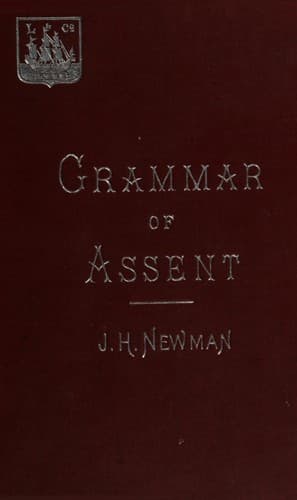
An Essay in Aid of a Grammar of AssentNewman, John Henry
Religion
An Essay in Aid of a Grammar of Assent
Newman, John Henry
Faith; Theism
Certitude is a mental state: certainty is a quality of propositions.
Those propositions I call certain, which are such that I am certain of
them. Certitude is not a passive impression made upon the mind from
without, by argumentative compulsion, but in all concrete questions
(nay, even in abstract, for though the reasoning is abstract, the
mind which judges of it is concrete) it is an active recognition of
propositions as true, such as it is the duty of each individual himself
to exercise at the bidding of reason, and, when reason forbids, to
withhold. And reason never bids us be certain except on an absolute
proof; and such a proof can never be furnished to us by the logic of
words, for as certitude is of the mind, so is the act of inference
which leads to it. Every one who reasons, is his own centre; and no
expedient for attaining a common measure of minds can reverse this
truth;—but then the question follows, is there any _criterion_ of the
accuracy of an inference, such as may be our warrant that certitude
is rightly elicited in favour of the proposition inferred, since our
warrant cannot, as I have said, be scientific? I have already said that
the sole and final judgment on the validity of an inference in concrete
matter is committed to the personal action of the ratiocinative
faculty, the perfection or virtue of which I have called the Illative
Sense, a use of the word “sense” parallel to our use of it in “good
sense,” “common sense,” a “sense of beauty,” &c.;—and I own I do not
see any way to go farther than this in answer to the question. However,
I can at least explain my meaning more fully; and therefore I will now
speak, first of the sanction of the Illative Sense, next of its nature,
and then of its range.
§ 1. The Sanction of the Illative Sense.
We are in a world of facts, and we use them; for there is nothing else
to use. We do not quarrel with them, but we take them as they are, and
avail ourselves of what they can do for us. It would be out of place
to demand of fire, water, earth, and air their credentials, so to
say, for acting upon us, or ministering to us. We call them elements,
and turn them to account, and make the most of them. We speculate on
them at our leisure. But what we are still less able to doubt about
or annul, at our leisure or not, is that which is at once their
counterpart and their witness, I mean, ourselves. We are conscious of
the objects of external nature, and we reflect and act upon them, and
this consciousness, reflection, and action we call our rationality.
And as we use the (so called) elements without first criticizing
what we have no command over, so is it much more unmeaning in us to
criticize or find fault with our own nature, which is nothing else than
we ourselves, instead of using it according to the use of which it
ordinarily admits. Our being, with its faculties, mind and body, is a
fact not admitting of question, all things being of necessity referred
to it, not it to other things.
Public-domain text, read in full here on John Shaqi.
Reviews
Reviews
No reviews yet
Be the first to share your thoughts on this work.
Elsewhere in the archive
Join the Discussion
Join the discussion
Sign in to leave a comment or review.
Sign InorCreate an account