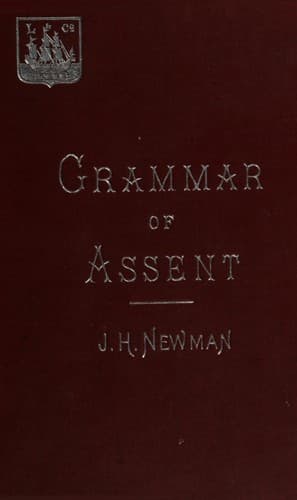
An Essay in Aid of a Grammar of AssentNewman, John Henry
Religion
An Essay in Aid of a Grammar of Assent
Newman, John Henry
Faith; Theism
It is the mind that reasons, and that controls its own reasonings,
not any technical apparatus of words and propositions. This power of
judging and concluding, when in its perfection, I call the Illative
Sense, and I shall best illustrate it by referring to parallel
faculties, which we commonly recognize without difficulty.
For instance, how does the mind fulfil its function of supreme
direction and control, in matters of duty, social intercourse,
and taste? In all of these separate actions of the intellect, the
individual is supreme, and responsible to himself, nay, under
circumstances, may be justified in opposing himself to the judgment
of the whole world; though he uses rules to his great advantage, as
far as they go, and is in consequence bound to use them. As regards
moral duty, the subject is fully considered in the well-known ethical
treatises of Aristotle.(31) He calls the faculty which guides the mind
in matters of conduct, by the name of _phronesis_, or judgment. This is
the directing, controlling, and determining principle in such matters,
personal and social. What it is to be virtuous, how we are to gain the
just idea and standard of virtue, how we are to approximate in practice
to our own standard, what is right and wrong in a particular case, for
the answers in fulness and accuracy to these and similar questions, the
philosopher refers us to no code of laws, to no moral treatise, because
no science of life, applicable to the case of an individual, has been
or can be written. Such is Aristotle’s doctrine, and it is undoubtedly
true. An ethical system may supply laws, general rules, guiding
principles, a number of examples, suggestions, landmarks, limitations,
cautions, distinctions, solutions of critical or anxious difficulties;
but who is to apply them to a particular case? whither can we go,
except to the living intellect, our own, or another’s? What is written
is too vague, too negative for our need. It bids us avoid extremes;
but it cannot ascertain for us, according to our personal need, the
golden mean. The authoritative oracle, which is to decide our path, is
something more searching and manifold than such jejune generalizations
as treatises can give, which are most distinct and clear when we least
need them. It is seated in the mind of the individual, who is thus his
own law, his own teacher, and his own judge in those special cases of
duty which are personal to him. It comes of an acquired habit, though
it has its first origin in nature itself, and it is formed and matured
by practice and experience; and it manifests itself, not in any breadth
of view, any philosophical comprehension of the mutual relations of
duty towards duty, or any consistency in its teachings, but it is a
capacity sufficient for the occasion, deciding what ought to be done
here and now, by this given person, under these given circumstances. It
decides nothing hypothetical, it does not determine what a man should
Public-domain text, read in full here on John Shaqi.
Reviews
Reviews
No reviews yet
Be the first to share your thoughts on this work.
Elsewhere in the archive
Join the Discussion
Join the discussion
Sign in to leave a comment or review.
Sign InorCreate an account