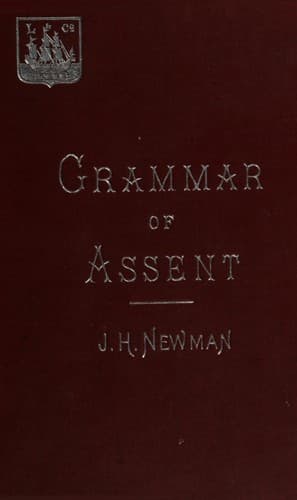
An Essay in Aid of a Grammar of AssentNewman, John Henry
Religion
An Essay in Aid of a Grammar of Assent
Newman, John Henry
Faith; Theism
It is natural, then, to ask the question, why ratiocination should
be an exception to a general law which attaches to the intellectual
exercises of the mind; why it is held to be commensurate with logical
science; and why logic is made an instrumental art sufficient for
determining every sort of truth, while no one would dream of making any
one formula, however generalized, a working rule at once for poetry,
the art of medicine, and political warfare?
This is what I have to remark concerning the Illative Sense, and in
explanation of its nature and claims; and on the whole, I have spoken
of it in four respects,—as viewed in itself, in its subject-matter, in
the process it uses, and in its function and scope.
First, viewed in its exercise, it is one and the same in all concrete
matters, though employed in them in different measures. We do not
reason in one way in chemistry or law, in another in morals or
religion; but in reasoning on any subject whatever, which is concrete,
we proceed, as far indeed as we can, by the logic of language, but we
are obliged to supplement it by the more subtle and elastic logic of
thought; for forms by themselves prove nothing.
Secondly, it is in fact attached to definite subject-matters, so that
a given individual may possess it in one department of thought, for
instance, history, and not in another, for instance, philosophy.
Thirdly, in coming to its conclusion, it proceeds always in the same
way, by a method of reasoning, which is the elementary principle of
that mathematical calculus of modern times, which has so wonderfully
extended the limits of abstract science.
Fourthly, in no class of concrete reasonings, whether in experimental
science, historical research, or theology, is there any ultimate test
of truth and error in our inferences besides the trustworthiness
of the Illative Sense that gives them its sanction; just as there
is no sufficient test of poetical excellence, heroic action, or
gentleman-like conduct, other than the particular mental sense, be it
genius, taste, sense of propriety, or the moral sense, to which those
subject-matters are severally committed. Our duty in each of these is
to strengthen and perfect the special faculty which is its living rule,
and in every case as it comes to do our best. And such also is our duty
and our necessity, as regards the Illative Sense.
§ 3. The Range of the Illative Sense.
Public-domain text, read in full here on John Shaqi.
Reviews
Reviews
No reviews yet
Be the first to share your thoughts on this work.
Elsewhere in the archive
Join the Discussion
Join the discussion
Sign in to leave a comment or review.
Sign InorCreate an account