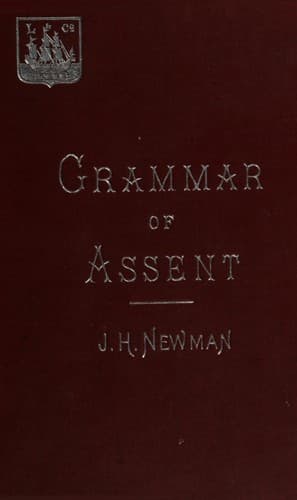
An Essay in Aid of a Grammar of AssentNewman, John Henry
Religion
An Essay in Aid of a Grammar of Assent
Newman, John Henry
Faith; Theism
Great as are the services of language in enabling us to extend the
compass of our inferences, to test their validity, and to communicate
them to others, still the mind itself is more versatile and vigorous
than any of its works, of which language is one, and it is only
under its penetrating and subtle action that the margin disappears,
which I have described as intervening between verbal argumentation
and conclusions in the concrete. It determines what science cannot
determine, the limit of converging probabilities and the reasons
sufficient for a proof. It is the ratiocinative mind itself, and no
trick of art, however simple in its form and sure in operation, by
which we are able to determine that a moving body left to itself will
never stop, and that no man can live without eating.
Nor, again, is it by any diagram that we are able to scrutinize, sort,
and combine the many premisses which must be first run together before
we answer duly a given question. It is to the living mind that we must
look for the means of using correctly principles of whatever kind,
facts or doctrines, experiences or testimonies, true or probable,
and of discerning what conclusion from these is necessary, suitable,
or expedient, when they are taken for granted; and this, either by
means of a natural gift, or from mental formation and practice and
a long familiarity with those various starting-points. Thus, when
Laud said that he did not see his way to come to terms with the Holy
See, “till Rome was other than she was,” no Catholic would admit the
sentiment: but any Catholic may understand that this is just the
judgment consistent with Laud’s actual condition of thought and cast
of opinions, his ecclesiastical position, and the existing state of
England.
Nor, lastly, is an action of the mind itself less necessary in
relation to those first elements of thought which in all reasoning
are assumptions, the principles, tastes, and opinions, very often of
a personal character, which are half the battle in the inference with
which the reasoning is to terminate. It is the mind itself that detects
them in their obscure recesses, illustrates them, establishes them,
eliminates them, resolves them into simpler ideas, as the case may
be. The mind contemplates them without the use of words, by a process
which cannot be analyzed. Thus it was that Bacon separated the physical
system of the world from the theological; thus that Butler connected
together the moral system with the religious. Logical formulas could
never have sustained the reasonings involved in such investigations.
Public-domain text, read in full here on John Shaqi.
Reviews
Reviews
No reviews yet
Be the first to share your thoughts on this work.
Elsewhere in the archive
Join the Discussion
Join the discussion
Sign in to leave a comment or review.
Sign InorCreate an account