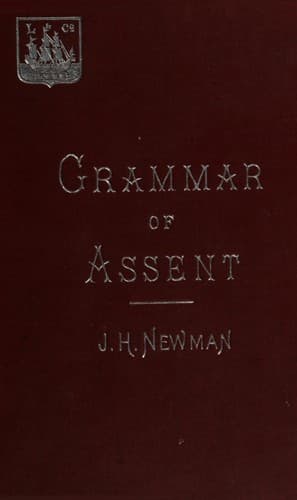
An Essay in Aid of a Grammar of Assent — John Shaqi
An Essay in Aid of a Grammar of AssentNewman, John Henry
Religion
An Essay in Aid of a Grammar of Assent
Newman, John Henry
Faith; Theism
Then, again, when men say they have no doubt of a thing, this is a
case, in which it is difficult to determine whether they assent to it,
infer it, or consider it highly probable. There are many cases, indeed,
in which it is impossible to discriminate between assent, inference,
and assertion, on account of the otiose, passive, inchoate character
of the act in question. If I say that to-morrow will be fine, what
does this enunciation mean? Perhaps it means that it ought to be fine,
if the glass tells truly; then it is the inference of a probability.
Perhaps it means no more than a surmise, because it is fine to-day, or
has been so for the week past. And perhaps it is a compliance with the
word of another, in which case it is sometimes a real assent, sometimes
a polite assertion or a wish.
Many a disciple of a philosophical school, who talks fluently, does but
assert, when he seems to assent to the _dicta_ of his master, little as
he may be aware of it. Nor is he secured against this self-deception
by knowing the arguments on which those _dicta_ rest, for he may learn
the arguments by heart, as a careless schoolboy gets up his Euclid.
This practice of asserting simply on authority, with the pretence and
without the reality of assent, is what is meant by formalism. To say
“I do not understand a proposition, but I accept it on authority,” is
not formalism, but faith; it is not a direct assent to the proposition,
still it _is_ an assent to the authority which enunciates it; but what
I here speak of is professing to understand without understanding. It
is thus that political and religious watchwords are created; first
one man of name and then another adopts them, till their use becomes
popular, and then every one professes them, because every one else
does. Such words are “liberality,” “progress,” “light,” “civilization;”
such are “justification by faith only,” “vital religion,” “private
judgment,” “the Bible and nothing but the Bible.” Such again are
“Rationalism,” “Gallicanism,” “Jesuitism,” “Ultramontanism”—all of
which, in the mouths of conscientious thinkers, have a definite
meaning, but are used by the multitude as war-cries, nicknames,
and shibboleths, with scarcely enough of the scantiest grammatical
apprehension of them to allow of their being considered really more
than assertions.
Public-domain text, read in full here on John Shaqi.
Reviews
Reviews
No reviews yet
Be the first to share your thoughts on this work.
Join the Discussion
Join the discussion
Sign in to leave a comment or review.
Sign InorCreate an account