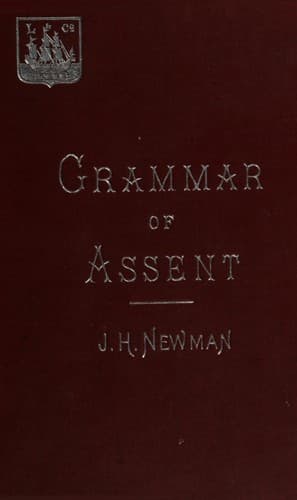
An Essay in Aid of a Grammar of AssentNewman, John Henry
Religion
An Essay in Aid of a Grammar of Assent
Newman, John Henry
Faith; Theism
I begin with expressing a sentiment, which is habitually in my
thoughts, whenever they are turned to the subject of mental or moral
science, and which I am as willing to apply here to the Evidences of
Religion as it properly applies to Metaphysics or Ethics, viz. that
in these provinces of inquiry egotism is true modesty. In religious
inquiry each of us can speak only for himself, and for himself he has
a right to speak. His own experiences are enough for himself, but
he cannot speak for others: he cannot lay down the law; he can only
bring his own experiences to the common stock of psychological facts.
He knows what has satisfied and satisfies himself; if it satisfies
him, it is likely to satisfy others; if, as he believes and is sure,
it is true, it will approve itself to others also, for there is but
one truth. And doubtless he does find in fact, that, allowing for the
difference of minds and of modes of speech, what convinces him, does
convince others also. There will be very many exceptions, but these
will admit of explanation. Great numbers of men refuse to inquire at
all; they put the subject of religion aside altogether; others are
not serious enough to care about questions of truth and duty and to
entertain them; and to numbers, from their temper of mind, or the
absence of doubt, or a dormant intellect, it does not occur to inquire
why or what they believe; many, though they tried, could not do so in
any satisfactory way. This being the case, it causes no uneasiness to
any one who honestly attempts to set down his own view of the Evidences
of Religion, that at first sight he seems to be but one among many
who are all in opposition to each other. But, however that may be, he
brings together his reasons, and relies on them, because they are his
own, and this is his primary evidence; and he has a second ground of
evidence, in the testimony of those who agree with him. But his best
evidence is the former, which is derived from his own thoughts; and it
is that which the world has a right to demand of him; and therefore
his true sobriety and modesty consists, not in claiming for his
conclusions an acceptance or a scientific approval which is not to be
found anywhere, but in stating what are personally his own grounds for
his belief in Natural and Revealed Religion,—grounds which he holds to
be so sufficient, that he thinks that others do hold them implicitly
or in substance, or would hold them, if they inquired fairly, or will
hold if they listen to him, or do not hold from impediments, invincible
or not as it may be, into which he has no call to inquire. However,
his own business is to speak for himself. He uses the words of the
Samaritans to their countrywoman, when our Lord had remained with them
for two days, “Now we believe, not for thy saying, for we have heard
Him ourselves, and know that this is indeed the Saviour of the world.”
Public-domain text, read in full here on John Shaqi.
Reviews
Reviews
No reviews yet
Be the first to share your thoughts on this work.
Elsewhere in the archive
Join the Discussion
Join the discussion
Sign in to leave a comment or review.
Sign InorCreate an account