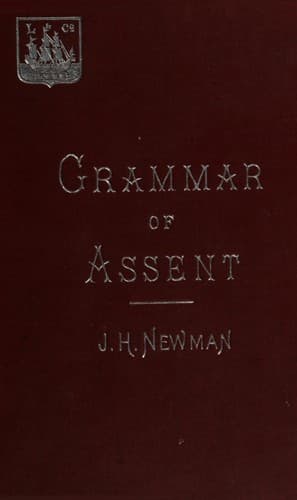
An Essay in Aid of a Grammar of AssentNewman, John Henry
Religion
An Essay in Aid of a Grammar of Assent
Newman, John Henry
Faith; Theism
Now Conscience suggests to us many things about that Master, whom
by means of it we perceive, but its most prominent teaching, and
its cardinal and distinguishing truth, is that He is our Judge.
In consequence, the special Attribute under which it brings Him
before us, to which it subordinates all other Attributes, is that of
justice—retributive justice. We learn from its informations to conceive
of the Almighty, primarily, not as a God of Wisdom, of Knowledge, of
Power, of Benevolence, but as a God of Judgment and Justice; as One,
who not simply for the good of the offender, but as an end good in
itself, and as a principle of government, ordains that the offender
should suffer for his offence. If it tells us anything at all of the
characteristics of the Divine Mind, it certainly tells us this; and,
considering that our shortcomings are far more frequent and important
than our fulfilment of the duties enjoined upon us, and that of this
point we are fully aware ourselves, it follows that the aspect under
which Almighty God is presented to us by Nature, is (to use a figure)
of One who is angry with us, and threatens evil. Hence its effect is
to burden and sadden the religious mind, and is in contrast with the
enjoyment derivable from the exercise of the affections, and from
the perception of beauty, whether in the material universe or in the
creations of the intellect. This is that fearful antagonism brought
out with such soul-piercing reality by Lucretius, when he speaks so
dishonourably of what he considers the heavy yoke of religion, and the
“æternas pœnas in morte timendum;” and, on the other hand, rejoices in
his “Alma Venus,” “quæ rerum naturam sola gubernas.” And we may appeal
to him for the fact, while we repudiate his view of it.
Public-domain text, read in full here on John Shaqi.
Reviews
Reviews
No reviews yet
Be the first to share your thoughts on this work.
Elsewhere in the archive
Join the Discussion
Join the discussion
Sign in to leave a comment or review.
Sign InorCreate an account