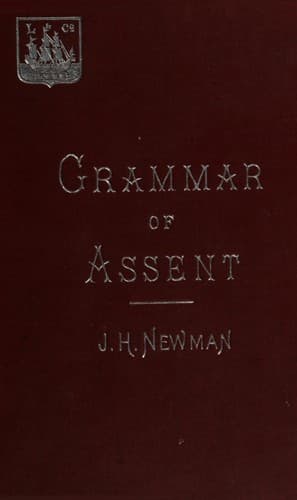
An Essay in Aid of a Grammar of AssentNewman, John Henry
Religion
An Essay in Aid of a Grammar of Assent
Newman, John Henry
Faith; Theism
These ceremonial acknowledgments, in so many distinct forms of worship,
of the existing degradation of the human race, of course imply a
brighter, as well as a threatening aspect of Natural Religion; for why
should men adopt any rites of deprecation or of purification at all,
unless they had some hope of attaining to a better condition than their
present? Of this happier side of religion I will speak presently; here,
however, a question of another kind occurs, viz. whether the notion of
atonement can be admitted among the doctrines of Natural Religion,—I
mean, on the ground that it is inconsistent with those teachings of
Conscience, which I have recognized above, as the rule and corrective
of every other information on the subject. If there is any truth
brought home to us by conscience, it is this, that we are personally
responsible for what we do, that we have no means of shifting our
responsibility, and that dereliction of duty involves punishment; how,
it may be asked, can acts of ours of any kind—how can even amendment of
life—undo the past? And if even our own subsequent acts of obedience
bring with them no promise of reversing what has once been committed,
how can external rites, or the actions of another (as of a priest),
be substitutes for that punishment which is the connatural fruit and
intrinsic development of violation of the sense of duty? I think this
objection avails as far as this, that amendment is no reparation, and
that no ceremonies or penances can in themselves exercise any vicarious
virtue in our behalf; and that, if they avail, they only avail in the
intermediate season of probation; that in some way we must make them
our own; and that, when the time comes, which conscience forebodes, of
our being called to judgment, then, at least, we shall have to stand in
and by ourselves, whatever we shall have by that time become, and must
bear our own burden. But it is plain that in this final account, as it
lies between us and our Master, He alone can decide how the past and
the present will stand together who is our Creator and our Judge.
Public-domain text, read in full here on John Shaqi.
Reviews
Reviews
No reviews yet
Be the first to share your thoughts on this work.
Elsewhere in the archive
Join the Discussion
Join the discussion
Sign in to leave a comment or review.
Sign InorCreate an account