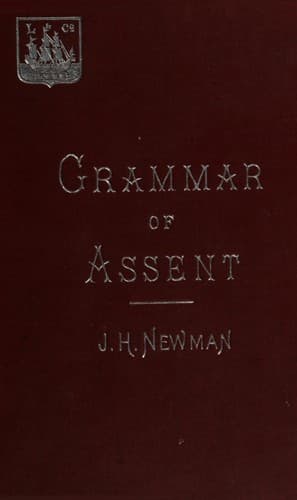
An Essay in Aid of a Grammar of AssentNewman, John Henry
Religion
An Essay in Aid of a Grammar of Assent
Newman, John Henry
Faith; Theism
In thus making it a necessary point to adjust the religions of the
world with the intimations of our conscience, I am suggesting the
reason why I confine myself to such religions as have had their rise in
barbarous times, and do not recognize the religion of what is called
civilization, as having legitimately a part in the delineation of
Natural Religion. It may at first sight seem strange, that, considering
I have laid such stress upon the progressive nature of man, I should
take my ideas of his religion from his initial, and not his final
testimony about its doctrines; and it may be urged that the religion
of civilized times is quite opposite in character to the rites and
traditions of barbarians, and has nothing of that gloom and sternness,
on which I have insisted as their characteristic. Thus the Greek
Mythology was for the most part cheerful and graceful, and the new
gods certainly more genial and indulgent than the old ones. And, in
like manner, the religion of philosophy is more noble and more humane
than those primitive conceptions which were sufficient for early kings
and warriors. But my answer to this objection is obvious: the progress
of which man’s nature is capable is a development, not a destruction
of its original state; it must subserve the elements from which it
proceeds, in order to be a true development and not a perversion.(36)
And it does in fact subserve and complete that nature with which man
is born. It is otherwise with the religion of so-called civilization;
such religion does but contradict the religion of barbarism; and since
this civilization itself is not a development of man’s whole nature,
but mainly of the intellect, recognizing indeed the moral sense, but
ignoring the conscience, no wonder that the religion in which it
issues has no sympathy either with the hopes and fears of the awakened
soul, or with those frightful presentiments which are expressed in the
worship and traditions of the heathen. This artificial religion, then,
has no place in the inquiry; first, because it comes of a one-sided
progress of mind, and next, for the very reason that it contradicts
informants which speak with greater authority than itself.
Public-domain text, read in full here on John Shaqi.
Reviews
Reviews
No reviews yet
Be the first to share your thoughts on this work.
Elsewhere in the archive
Join the Discussion
Join the discussion
Sign in to leave a comment or review.
Sign InorCreate an account