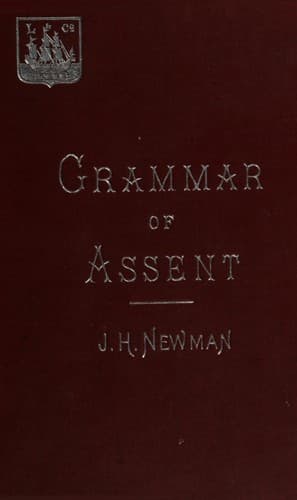
An Essay in Aid of a Grammar of AssentNewman, John Henry
Religion
An Essay in Aid of a Grammar of Assent
Newman, John Henry
Faith; Theism
The first of these laws, relieving the aspect of Natural Religion, is
the very fact that religious beliefs and institutions, of some kind
or other, are of such general acceptance in all times and places. Why
should men subject themselves to the tyranny which Lucretius denounces,
unless they had either experience or hope of benefits to themselves
by so doing? Though it be mere hope of benefits, that alone is a
great alleviation of the gloom and misery which their religious rites
presuppose or occasion; for thereby they have a prospect, more or less
clear, of some happier state in reserve for them, or at least the
chances of it. If they simply despaired of their fortunes, they would
not care about religion. And hope of future good, as we know, sweetens
all suffering.
Moreover, they have an earnest of that future in the real and recurring
blessings of life, the enjoyment of the gifts of the earth, and of
domestic affection and social intercourse, which is sufficient to
touch and to subdue even the most guilty of men in his better moments,
reminding him that he is not utterly cast off by Him whom nevertheless
he is not given to know. Or, in the Apostle’s words, though the Creator
once “suffered all nations to walk in their own ways,” still, “He left
not Himself without testimony, doing good from heaven, giving rains and
fruitful seasons, filling our hearts with food and gladness.”
Nor are these blessings of physical nature the only tokens in the
Divine System, which in that heathen time, and indeed in every
age, bring home to our experience the fact of a Good God, in spite
of the tumult and confusion of the world. It is possible to give
an interpretation to the course of things, by which every event
or occurrence in its order becomes providential: and though that
interpretation does not hold good unless the world is contemplated
from a particular point of view, in one given aspect, and with certain
inward experiences, and personal first principles and judgments,
yet these may be fairly pronounced to be common conditions of human
thought, that is, till they are wilfully or accidentally lost; and
they issue in fact, in leading the great majority of men to recognize
the Hand of unseen power, directing in mercy or in judgment the
physical and moral system. In the prominent events of the world, past
and contemporary, the fate, evil or happy, of great men, the rise and
fall of states, popular revolutions, decisive battles, the migration
of races, the replenishing of the earth, earthquakes and pestilences,
critical discoveries and inventions, the history of philosophy, the
advancement of knowledge, in these the spontaneous piety of the
human mind discerns a Divine Supervision. Nay, there is a general
feeling, originating directly in the workings of conscience, that a
similar governance is extended over the persons of individuals, who
thereby both fulfil the purposes and receive the just recompenses of
an Omnipotent Providence.
Public-domain text, read in full here on John Shaqi.
Reviews
Reviews
No reviews yet
Be the first to share your thoughts on this work.
Elsewhere in the archive
Join the Discussion
Join the discussion
Sign in to leave a comment or review.
Sign InorCreate an account