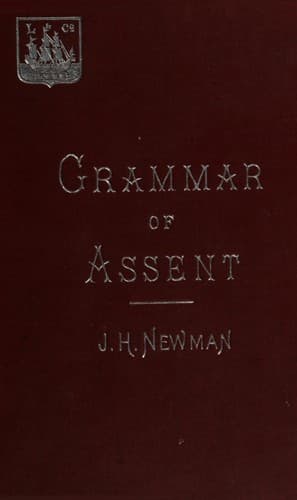
An Essay in Aid of a Grammar of AssentNewman, John Henry
Religion
An Essay in Aid of a Grammar of Assent
Newman, John Henry
Faith; Theism
I have implied that the laws on which this world is governed do not
go so far as to prove that evil will never die out of the creation;
nevertheless, they look in that direction. No experience indeed of
life can assure us about the future, but it can and does give us means
of conjecturing what is likely to be; and those conjectures coincide
with our natural forebodings. Experience enables us to ascertain the
moral constitution of man, and thereby to presage his future from
his present. It teaches us, first, that he is not sufficient for
his own happiness, but is dependent upon the sensible objects which
surround him, and that these he cannot take with him when he leaves
the world; secondly, that disobedience to his sense of right is even
by itself misery, and that he carries that misery about him, wherever
he is, though no divine retribution followed upon it; and thirdly,
that he cannot change his nature and his habits by wishing, but is
simply himself, and will ever be himself and what he now is, wherever
he is, as long as he continues to be,—or at least that pain has no
natural tendency to make him other than he is, and that the longer he
lives, the more difficult he is to change. How can we meet these not
irrational anticipations, except by shutting our eyes, turning away
from them, and saying that we have no call, no right, to think of them
at present, or to make ourselves miserable about what is not certain,
and may be not true?(38)
Such is the severe aspect of Natural Religion: also it is the most
prominent aspect, because the multitude of men follow their own likings
and wills, and not the decisions of their sense of right and wrong.
To them Religion is a mere yoke, as Lucretius describes it; not a
satisfaction or refuge, but a terror and a superstition. However, I
must not for an instant be supposed to mean, that this is its only, its
chief, or its legitimate aspect. All Religion, so far as it is genuine,
is a blessing, Natural as well as Revealed. I have insisted on its
severe aspect in the first place, because, from the circumstances of
human nature, though not by the fault of Religion, such is the shape
in which we first encounter it. Its large and deep foundation is the
sense of sin and guilt, and without this sense there is for man, as he
is, no genuine religion. Otherwise, it is but counterfeit and hollow;
and that is the reason why this so-called religion of civilization
and philosophy is so great a mockery. However, true as this judgment
is which I pass on philosophical religion, and troubled as are the
existing relations between God and man, as both the voice of mankind
and the facts of Divine Government testify, equally true are other
general laws which govern those relations, and they speak another
language, and compensate for what is stern in the teaching of nature,
without tending to deny that sternness.
Public-domain text, read in full here on John Shaqi.
Reviews
Reviews
No reviews yet
Be the first to share your thoughts on this work.
Elsewhere in the archive
Join the Discussion
Join the discussion
Sign in to leave a comment or review.
Sign InorCreate an account