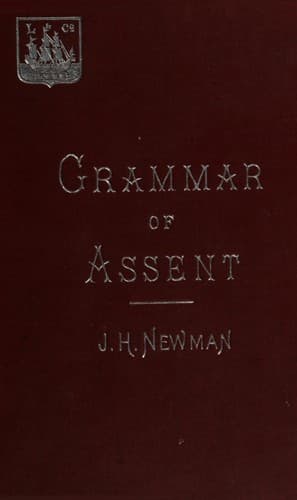
An Essay in Aid of a Grammar of AssentNewman, John Henry
Religion
An Essay in Aid of a Grammar of Assent
Newman, John Henry
Faith; Theism
This leads me to the question, whether belief in a mystery can be more
than an assertion. I consider it can be an assent, and my reasons
for saying so are as follows:—A mystery is a proposition conveying
incompatible notions, or is a statement of the inconceivable. Now we
can assent to propositions (and a mystery is a proposition), provided
we can apprehend them; therefore we can assent to a mystery, for,
unless we in some sense apprehended it, we should not recognize it
to be a mystery, that is, a statement uniting incompatible notions.
The same act, then, which enables us to discern that the words of
the proposition express a mystery, capacitates us for assenting to
it. Words which make nonsense, do not make a mystery. No one would
call Warton’s line—“Revolving swans proclaim the welkin near”—an
inconceivable assertion. It is equally plain, that the assent which
we give to mysteries, as such, is notional assent; for, by the
supposition, it is assent to propositions which we cannot conceive,
whereas, if we had had experience of them, we should be able to
conceive them, and without experience assent is not real.
But the question follows, Can processes of inference end in a mystery?
that is, not only in what is incomprehensible, that the stars are
billions of miles from each other, but in what is inconceivable, in the
co-existence of (seeming) incompatibilities? For how, it may be asked,
can reason carry out notions into their contradictories? since all the
developments of a truth must from the nature of the case be consistent
both with it and with each other. I answer, certainly processes of
inference, however accurate, can end in mystery; and I solve the
objection to such a doctrine thus:—our notion of a thing may be only
partially faithful to the original; it may be in excess of the thing,
or it may represent it incompletely, and, in consequence, it may serve
for it, it may stand for it, only to a certain point, in certain cases,
but no further. After that point is reached, the notion and the thing
part company; and then the notion, if still used as the representative
of the thing, will work out conclusions, not inconsistent with itself,
but with the thing to which it no longer corresponds.
Public-domain text, read in full here on John Shaqi.
Reviews
Reviews
No reviews yet
Be the first to share your thoughts on this work.
Join the Discussion
Join the discussion
Sign in to leave a comment or review.
Sign InorCreate an account