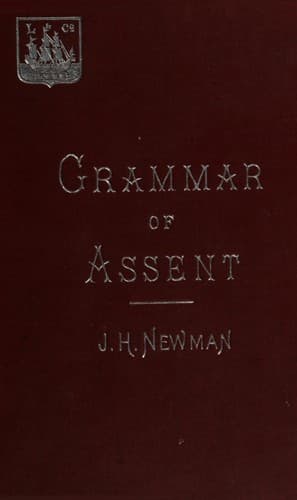
An Essay in Aid of a Grammar of AssentNewman, John Henry
Religion
An Essay in Aid of a Grammar of Assent
Newman, John Henry
Faith; Theism
One concluding remark has to be made here. In all sacrifices it
was specially required that the thing offered should be something
rare, and unblemished; and in like manner in all atonements and all
satisfactions, not only was the innocent taken for the guilty, but it
was a point of special importance that the victim should be spotless,
and the more manifest that spotlessness, the more efficacious was the
sacrifice. This leads me to a last principle which I shall notice as
proper to Natural Religion, and as lightening the prophecies of evil in
which it is founded; I mean the doctrine of meritorious intercession.
The man in the Gospel did but speak for the human race everywhere, when
he said, “God heareth not sinners; but if a man be a worshipper of God,
and doth His will, him He heareth.” Hence every religion has had its
eminent devotees, exalted above the body of the people, mortified men,
brought nearer to the Source of good by austerities, self-inflictions,
and prayer, who have influence with Him, and extend a shelter and
gain blessings for those who become their clients. A belief like this
has been, of course, attended by numberless superstitions; but those
superstitions vary with times and places, and the belief itself in
the mediatorial power of the good and holy has been one and the same
everywhere. Nor is this belief an idea of past times only or of heathen
countries. It is one of the most natural visions of the young and
innocent. And all of us, the more keenly we feel our own distance from
holy persons, the more are we drawn near to them, as if forgetting that
distance, and proud of them because they are so unlike ourselves, as
being specimens of what our nature may be, and with some vague hope
that we, their relations by blood, may profit in our own persons by
their holiness.
Such, then, in outline is that system of natural beliefs and
sentiments, which, though true and divine, is still possible to us
independently of Revelation, and is the preparation for it; though
in Christians themselves it cannot really be separated from their
Christianity, and never is possessed in its higher forms in any people
without some portion of those inward aids which Christianity imparts
to us, and those endemic traditions which have their first origin in a
paradisiacal illumination.
§ 2. Revealed Religion.
Public-domain text, read in full here on John Shaqi.
Reviews
Reviews
No reviews yet
Be the first to share your thoughts on this work.
Elsewhere in the archive
Join the Discussion
Join the discussion
Sign in to leave a comment or review.
Sign InorCreate an account