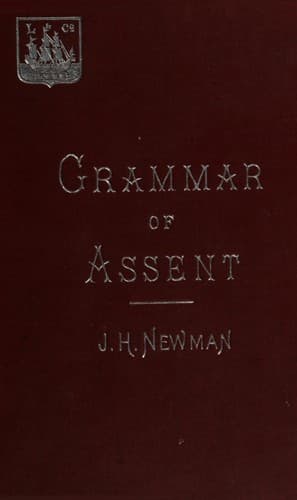
An Essay in Aid of a Grammar of AssentNewman, John Henry
Religion
An Essay in Aid of a Grammar of Assent
Newman, John Henry
Faith; Theism
Relying then on these authorities, human and Divine, I have no scruple
in beginning the review I shall take of Christianity by professing
to consult for those only whose minds are properly prepared for it;
and by being prepared, I mean to denote those who are imbued with the
religious opinions and sentiments which I have identified with Natural
Religion. I do not address myself to those, who in moral evil and
physical see nothing more than imperfections of a parallel nature;
who consider that the difference in gravity between the two is one of
degree only, not of kind; that moral evil is merely the offspring of
physical, and that as we remove the latter so we inevitably remove
the former; that there is a progress of the human race which tends to
the annihilation of moral evil; that knowledge is virtue, and vice is
ignorance; that sin is a bugbear, not a reality; that the Creator does
not punish except in the sense of correcting; that vengeance in Him
would of necessity be vindictiveness; that all that we know of Him, be
it much or little, is through the laws of nature; that miracles are
impossible; that prayer to Him is a superstition; that the fear of Him
is unmanly; that sorrow for sin is slavish and abject; that the only
intelligible worship of Him is to act well our part in the world, and
the only sensible repentance to do better in future; that if we do our
duties in this life, we may take our chance for the next; and that it
is of no use perplexing our minds about the future state, for it is all
a matter of guess. These opinions characterize a civilized age; and if
I say that I will not argue about Christianity with men who hold them,
I do so, not as claiming any right to be impatient or peremptory with
any one, but because it is plainly absurd to attempt to prove a second
proposition to those who do not admit the first.
I assume then that the above system of opinion is simply false,
inasmuch as it contradicts the primary teachings of nature in the human
race, wherever a religion is found and its workings can be ascertained.
I assume the Presence of God in our conscience, and the universal
experience, as keen as our experience of bodily pain, of what we call a
sense of sin or guilt. This sense of sin, as of something not only evil
in itself, but an affront to the good God, is chiefly felt as regards
one or other of three violations of His Law. He Himself is Sanctity,
Truth, and Love; and the three offences against His Majesty are
impurity, inveracity, and cruelty. All men are not distressed at these
offences alike; but the piercing pain and sharp remorse which one or
other inflicts upon the mind, till habituated to them, brings home to
it the notion of what sin is, and is the vivid type and representative
of its intrinsic hatefulness.
Public-domain text, read in full here on John Shaqi.
Reviews
Reviews
No reviews yet
Be the first to share your thoughts on this work.
Elsewhere in the archive
Join the Discussion
Join the discussion
Sign in to leave a comment or review.
Sign InorCreate an account