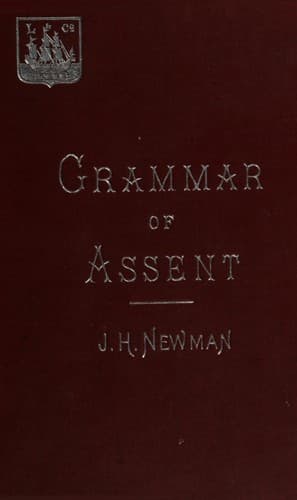
An Essay in Aid of a Grammar of AssentNewman, John Henry
Religion
An Essay in Aid of a Grammar of Assent
Newman, John Henry
Faith; Theism
That a special preparation of mind is required for each separate
department of inquiry and discussion (excepting, of course, that of
abstract science) is strongly insisted upon in well-known passages of
the Nicomachean Ethics. Speaking of the variations which are found in
the logical perfection of proof in various subject-matters, Aristotle
says, “A well-educated man will expect exactness in every class of
subjects, according as the nature of the thing admits; for it is much
the same mistake to put up with a mathematician using probabilities,
and to require demonstration of an orator. Each man judges skilfully in
those things about which he is well-informed; it is of these, that he
is a good judge; viz. he, in each subject-matter, is a judge, who is
well-educated in that subject-matter, and he is in an absolute sense
a judge, who is in all of them well-educated.” Again: “Young men come
to be mathematicians and the like, but they cannot possess practical
judgment; for this talent is employed upon individual facts, and these
are learned only by experience; and a youth has not experience, for
experience is only gained by a course of years. And so, again, it would
appear that a boy may be a mathematician, but not a philosopher, or
learned in physics, and for this reason,—because the one study deals
with abstractions, while the other studies gain their principles from
experience, and in the latter subjects youths do not give assent, but
make assertions, but in the former they know what it is that they are
handling.”
These words of a heathen philosopher, laying down broad principles
about all knowledge, express a general rule, which in Scripture
is applied authoritatively to the case of revealed knowledge in
particular;—and that not once or twice only, but continually, as is
notorious. For instance:—“I have understood,” says the Psalmist, “more
than all my teachers, because Thy testimonies are my meditation.”
And so our Lord: “He that hath ears, let him hear.” “If any man will
do His will, he shall know of the doctrine.” And “He that is of God,
heareth the words of God.” Thus too the Angels at the Nativity announce
“Peace to men of good will.” And we read in the Acts of the Apostles
of “Lydia, whose heart the Lord opened to attend to those things which
were said by Paul.” And we are told on another occasion, that “as many
as were ordained,” or disposed by God, “to life everlasting, believed.”
And St. John tells us, “He that knoweth God, heareth us; he that is not
of God, heareth us not; by this we know the spirit of truth, and the
spirit of error.”
1.
Public-domain text, read in full here on John Shaqi.
Reviews
Reviews
No reviews yet
Be the first to share your thoughts on this work.
Elsewhere in the archive
Join the Discussion
Join the discussion
Sign in to leave a comment or review.
Sign InorCreate an account