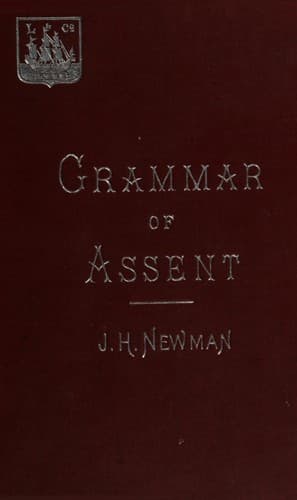
An Essay in Aid of a Grammar of AssentNewman, John Henry
Religion
An Essay in Aid of a Grammar of Assent
Newman, John Henry
Faith; Theism
mythological rites in which the place abounded.
Here my method of argument differs from that adopted by Paley in his
Evidences of Christianity. This clear-headed and almost mathematical
reasoner postulates, for his proof of its miracles, only thus much,
that, under the circumstances of the case, a revelation is not
improbable. He says, “We do not assume the attributes of the Deity,
or the existence of a future state.” “It is not necessary for our
purpose that these propositions (viz. that a future existence should be
destined by God for His human creation, and that, being so destined,
He should have acquainted them with it,) be capable of proof, or even
that, by arguments drawn from the light of nature, they can be made out
as probable; it is enough that we are able to say of them, that they
are not so violently improbable, so contradictory to what we already
believe of the divine power and character, that [they] ought to be
rejected at first sight, and to be rejected by whatever strength or
complication of evidence they be attested.” He has such confidence in
the strength of the testimony which he can produce in favour of the
Christian miracles, that he only asks to be allowed to bring it into
court.
I confess to much suspicion of legal proceedings and legal arguments,
when used in questions whether of history or of philosophy. Rules
of court are dictated by what is expedient on the whole and in the
long run; but they incur the risk of being unjust to the claims of
particular cases. Why am I to begin with taking up a position not my
own, and unclothing my mind of that large outfit of existing thoughts,
principles, likings, desires, and hopes, which make me what I am? If I
am asked to use Paley’s argument for my own conversion, I say plainly
I do not want to be converted by a smart syllogism;(43) if I am asked
to convert others by it, I say plainly I do not care to overcome
their reason without touching their hearts. I wish to deal, not with
controversialists, but with inquirers.
I think Paley’s argument clear, clever, and powerful; and there is
something which looks like charity in going out into the highways and
hedges, and compelling men to come in; but in this matter some exertion
on the part of the persons whom I am to convert is a condition of a
true conversion. They who have no religious earnestness are at the
mercy, day by day, of some new argument or fact, which may overtake
them, in favour of one conclusion or the other. And how, after all,
is a man better for Christianity, who has never felt the need of it
or the desire? On the other hand, if he has longed for a revelation
to enlighten him and to cleanse his heart, why may he not use, in
his inquiries after it, that just and reasonable anticipation of its
probability, which such longing has opened the way to his entertaining?
Public-domain text, read in full here on John Shaqi.
Reviews
Reviews
No reviews yet
Be the first to share your thoughts on this work.
Elsewhere in the archive
Join the Discussion
Join the discussion
Sign in to leave a comment or review.
Sign InorCreate an account