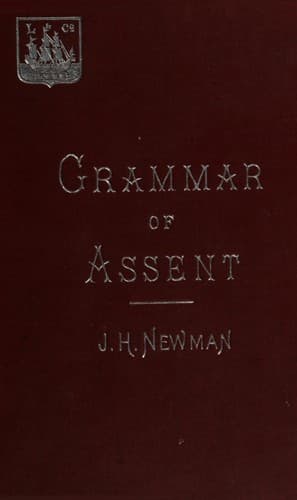
An Essay in Aid of a Grammar of AssentNewman, John Henry
Religion
An Essay in Aid of a Grammar of Assent
Newman, John Henry
Faith; Theism
Men are too well inclined to sit at home, instead of stirring
themselves to inquire whether a revelation has been given; they expect
its evidences to come to them without their trouble; they act, not
as suppliants, but as judges.(44) Modes of argument such as Paley’s,
encourage this state of mind; they allow men to forget that revelation
is a boon, not a debt on the part of the Giver; they treat it as a mere
historical phenomenon. If I was told that some great man, a foreigner,
whom I did not know, had come into town, and was on his way to call
on me, and to go over my house, I should send to ascertain the fact,
and meanwhile should do my best to put my house into a condition to
receive him. He would not be pleased if I left the matter to take
its chance, and went on the maxim that seeing was believing. Like
this is the conduct of those who resolve to treat the Almighty with
dispassionateness, a judicial temper, clearheadedness, and candour. It
is the way with some men, (surely not a good way,) to say, that without
these lawyerlike qualifications conversion is immoral. It is their way,
a miserable way, to pronounce that there is no religious love of truth
where there is fear of error. On the contrary, I would maintain that
the fear of error is simply necessary to the genuine love of truth.
No inquiry comes to good which is not conducted under a deep sense of
responsibility, and of the issues depending upon its determination.
Even the ordinary matters of life are an exercise of conscientiousness;
and where conscience is, fear must be. So much is this acknowledged
just now, that there is almost an affectation, in popular literature,
in the case of criticisms on the fine arts, on poetry, and music, of
speaking about conscientiousness in writing, painting, or singing; and
that earnestness and simplicity of mind, which makes men fear to go
wrong in these minor matters, has surely a place in the most serious of
all undertakings.
It is on these grounds that, in considering Christianity, I start
with conditions different from Paley’s; not, however, as undervaluing
the force and the serviceableness of his argument, but as preferring
inquiry to disputation in a question about truth.
4.
Public-domain text, read in full here on John Shaqi.
Reviews
Reviews
No reviews yet
Be the first to share your thoughts on this work.
Elsewhere in the archive
Join the Discussion
Join the discussion
Sign in to leave a comment or review.
Sign InorCreate an account