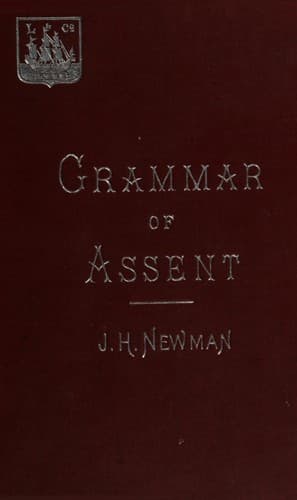
An Essay in Aid of a Grammar of AssentNewman, John Henry
Religion
An Essay in Aid of a Grammar of Assent
Newman, John Henry
Faith; Theism
Are we to say that this failure is a proof that, after all, there was
nothing providential in their history? For myself, I do not see how a
second portent obliterates a first; and, in truth, their own testimony
and their own sacred books carry us on towards a better solution
of the difficulty. I have said they were in God’s favour under a
covenant,—perhaps they did not fulfil the conditions of it. This indeed
seems to be their own account of the matter, though it is not clear
what their breach of engagement was. And that in some way they did sin,
whatever their sin was, is corroborated by the well-known chapter in
the Book of Deuteronomy, which so strikingly anticipates the nature
of their punishment. That passage, translated into Greek as many as
350 years before the siege of Jerusalem by Titus, has on it the marks
of a wonderful prophecy; but I am not now referring to it as such,
but merely as an indication that the disappointment, which actually
overtook them at the Christian era, was not necessarily out of keeping
with the original divine purpose, or again with the old promise made to
them, and their confident expectation of its fulfilment. Their national
ruin, which came instead of aggrandizement, is described in that book,
in spite of all promises, with an emphasis and minuteness which prove
that it was contemplated long before, at least as a possible issue of
the fortunes of Israel. Among other inflictions which should befall the
guilty people, it was told them that they should fall down before their
enemies, and should be scattered throughout all the kingdoms of the
earth; that they never should have quiet in those nations, or have rest
for the sole of their foot; that they were to have a fearful heart and
languishing eyes, and a soul consumed with heaviness; that they were
to suffer wrong, and to be crushed at all times, and to be astonished
at the terror of their lot; that their sons and daughters were to be
given to another people, and they were to look and to sicken all the
day, and their life was ever to hang in doubt before them, and fear to
haunt them day and night; that they should be a proverb and a by-word
of all people among whom they were brought; and that curses were to
come on them, and to be signs and wonders on them and their seed for
ever. Such are some portions, and not the most terrible, of this
extended anathema; and its partial accomplishment at an earlier date of
their history was a warning to them, when the destined time drew near,
that, however great the promises made to them might be, those promises
were dependent on the terms of the covenant which stood between them
and their Maker, and that, as they had turned to curses at that former
time, so they might turn to curses again.
Public-domain text, read in full here on John Shaqi.
An Essay in Aid of a Grammar of Assent — John Shaqi
Reviews
Reviews
No reviews yet
Be the first to share your thoughts on this work.
Elsewhere in the archive
Join the Discussion
Join the discussion
Sign in to leave a comment or review.
Sign InorCreate an account