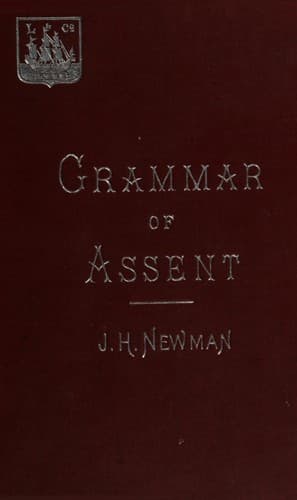
An Essay in Aid of a Grammar of AssentNewman, John Henry
Religion
An Essay in Aid of a Grammar of Assent
Newman, John Henry
Faith; Theism
This grand drama, so impressed with the characters of supernatural
agency, concerns us here only in its bearing upon the evidence for
the divine origin of Christianity; and it is at this point that
Christianity comes upon the historical scene. It is a notorious fact
that it issued from the Jewish land and people; and, had it no other
than this historical connexion with Judaism, it would have some share
in the prestige of its original home. But it claims to be far more
than this; it professes to be the actual completion of the Mosaic Law,
the promised means of deliverance and triumph to the nation, which
that nation itself, as I have said, has since considered to be, on
account of some sin or other, withheld or forfeited. It professes to
be, not the casual, but the legitimate offspring, heir, and successor
of the Mosaic covenant, or rather to be Judaism itself, developed and
transformed. Of course it has to prove its claim, as well as to prefer
it; but if it succeeds in doing so, then all those tokens of the Divine
Presence, which distinguish the Jewish history, at once belong to it,
and are a portion of its credentials.
And at least the _primâ facie_ view of its relations towards Judaism
is in favour of these pretensions. It is an historical fact, that, at
the very time that the Jews committed their unpardonable sin, whatever
it was, and were driven out from their home to wander over the earth,
their Christian brethren, born of the same stock, and equally citizens
of Jerusalem, did also issue forth from the same home, but in order to
subdue that same earth and make it their own; that is, they undertook
the very work which, according to the promise, their nation actually
was ordained to execute; and, with a method of their own indeed, and
with a new end, and only slowly and painfully, but still really and
thoroughly, they did it. And since that time the two children of the
promise have ever been found together—of the promise forfeited and the
promise fulfilled; and whereas the Christian has been in high place,
so the Jew has been degraded and despised—the one has been “the head,”
and the other “the tail;” so that, to go no farther, the fact that
Christianity actually has done what Judaism was to have done, decides
the controversy, by the logic of facts, in favour of Christianity.
The prophecies announced that the Messiah was to come at a definite
time and place; Christians point to Him as coming then and there, as
announced; they are not met by any counter claim or rival claimant on
the part of the Jews, only by their assertion that He did not come at
all, though up to the event they had said He was then and there coming.
Further, Christianity clears up the mystery which hangs over Judaism,
accounting fully for the punishment of the people, by specifying their
sin, their heinous sin. If, instead of hailing their own Messiah,
they crucified Him, then the strange scourge which has pursued them
Public-domain text, read in full here on John Shaqi.
Reviews
Reviews
No reviews yet
Be the first to share your thoughts on this work.
Elsewhere in the archive
Join the Discussion
Join the discussion
Sign in to leave a comment or review.
Sign InorCreate an account