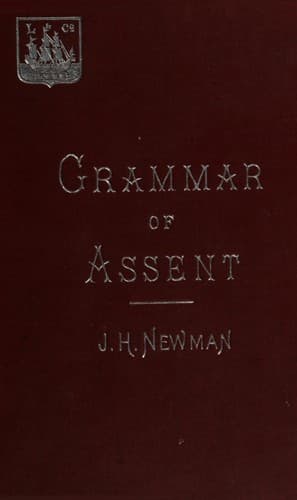
An Essay in Aid of a Grammar of AssentNewman, John Henry
Religion
An Essay in Aid of a Grammar of Assent
Newman, John Henry
Faith; Theism
Yet it is plain, and I shall take it for granted here, that when
I assent to a proposition, I ought to have some more legitimate
reason for doing so, than the brilliancy of the image of which that
proposition is the expression. That I have no experience of a thing
happening except in one way, is a cause of the intensity of my assent,
if I assent, but not the reason of my assenting. In saying this, I
am not disposed to deny the presence in some men of an idiosyncratic
sagacity, which really and rightly sees reasons in impressions which
common men cannot see, and is secured from the peril of confusing truth
with make-belief; but this is genius, and beyond rule. I grant too, of
course, that accidentally impressiveness does in matter of fact, as in
the instance which I have been giving, constitute the motive principle
of belief; for the mind is ever exposed to the danger of being carried
away by the liveliness of its conceptions, to the sacrifice of good
sense and conscientious caution, and the greater and the more rare are
its gifts, the greater is the risk of swerving from the line of reason
and duty; but here I am not speaking of transgressions of rule any more
than of exceptions to it, but of the normal constitution of our minds,
and of the natural and rightful effect of acts of the imagination upon
us, and this is, not to create assent, but to intensify it.
2. Next, Assent, however strong, and accorded to images however
vivid, is not therefore necessarily practical. Strictly speaking, it
is not imagination that causes action; but hope and fear, likes and
dislikes, appetite, passion, affection, the stirrings of selfishness
and self-love. What imagination does for us is to find a means of
stimulating those motive powers; and it does so by providing a supply
of objects strong enough to stimulate them. The thought of honour,
glory, duty, self-aggrandisement, gain, or on the other hand of Divine
Goodness, future reward, eternal life, perseveringly dwelt upon, leads
us along a course of action corresponding to itself, but only in case
there be that in our minds which is congenial to it. However, when
there is that preparation of mind, the thought does lead to the act.
Hence it is that the fact of a proposition being accepted with a real
assent is accidentally an earnest of that proposition being carried out
in conduct, and the imagination may be said in some sense to be of a
practical nature, inasmuch as it leads to practice indirectly by the
action of its object upon the affections.
Public-domain text, read in full here on John Shaqi.
Reviews
Reviews
No reviews yet
Be the first to share your thoughts on this work.
Elsewhere in the archive
Join the Discussion
Join the discussion
Sign in to leave a comment or review.
Sign InorCreate an account