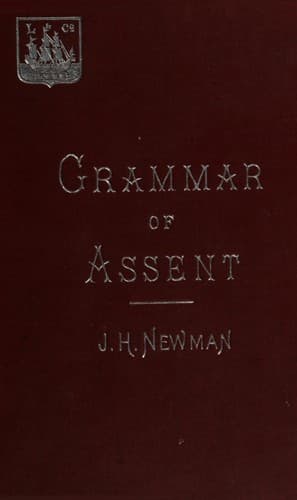
An Essay in Aid of a Grammar of AssentNewman, John Henry
Religion
An Essay in Aid of a Grammar of Assent
Newman, John Henry
Faith; Theism
“Science gives us the grounds or premisses from which religious truths
are to be enforced; but it does not set about inferring them, much
less does it reach the inference—that is not its province. It brings
before us phenomena, and it leaves us, if we will, to call them works
of design, wisdom, or benevolence; and further still, if we will, to
proceed to confess an Intelligent Creator. We have to take its facts,
and to give them a meaning, and to draw our own conclusions from them.
First comes knowledge, then a view, then reasoning, and then belief.
This is why science has so little of a religious tendency; deductions
have no power of persuasion. The heart is commonly reached, not
through the reason, but through the imagination, by means of direct
impressions, by the testimony of facts and events, by history, by
description. Persons influence us, voices melt us, looks subdue us,
deeds inflame us. Many a man will live and die upon a dogma: no man
will be a martyr for a conclusion. A conclusion is but an opinion; it
is not a thing which _is_, but which we are ‘_quite sure about_;’ and
it has often been observed, that we never say we are sure and certain
without implying that we doubt. To say that a thing _must_ be, is
to admit that it _may not_ be. No one, I say, will die for his own
calculations: he dies for realities. This is why a literary religion
is so little to be depended upon; it looks well in fair weather; but
its doctrines are opinions, and, when called to suffer for them, it
slips them between its folios, or burns them at its hearth. And this
again is the secret of the distrust and raillery with which moralists
have been so commonly visited. They say and do not. Why? Because they
are contemplating the fitness of things, and they live by the square,
when they should be realizing their high maxims in the concrete. Now
Sir Robert Peel thinks better of natural history, chemistry, and
astronomy than of such ethics; but these too, what are they more than
divinity _in posse_? He protests against ‘_controversial_ divinity:’ is
_inferential_ much better?
“I have no confidence, then, in philosophers who cannot help being
religious, and are Christians by implication. They sit at home, and
reach forward to distances which astonish us; but they hit without
grasping, and are sometimes as confident about shadows as about
realities. They have worked out by a calculation the lie of a country
which they never saw, and mapped it by means of a gazetteer; and, like
blind men, though they can put a stranger on his way, they cannot walk
straight themselves, and do not feel it quite their business to walk at
all.
Public-domain text, read in full here on John Shaqi.
Reviews
Reviews
No reviews yet
Be the first to share your thoughts on this work.
Elsewhere in the archive
Join the Discussion
Join the discussion
Sign in to leave a comment or review.
Sign InorCreate an account