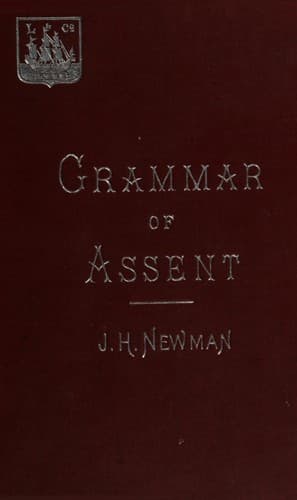
An Essay in Aid of a Grammar of Assent — John Shaqi
An Essay in Aid of a Grammar of AssentNewman, John Henry
Religion
An Essay in Aid of a Grammar of Assent
Newman, John Henry
Faith; Theism
As the multitude of common nouns have originally been singular, it
is not surprising that many of them should so remain still in the
apprehension of particular individuals. In the proposition “Sugar
is sweet,” the predicate is a common noun as used by those who have
compared sugar in their thoughts with honey or glycerine; but it may be
the only distinctively sweet thing in the experience of a child, and
may be used by him as a noun singular. The first time that he tastes
sugar, if his nurse says, “Sugar is sweet” in a notional sense, meaning
by sugar, lump-sugar, powdered, brown, and candied, and by sweet, a
specific flavour or scent which is found in many articles of food and
many flowers, he may answer in a real sense, and in an individual
proposition “Sugar is sweet,” meaning “this sugar is this sweet thing.”
Thirdly, in the same mind and at the same time, the same proposition
may express both what is notional and what is real. When a lecturer in
mechanics or chemistry shows to his class by experiment some physical
fact, he and his hearers at once enunciate it as an individual thing
before their eyes, and also as generalized by their minds into a law of
nature. When Virgil says, “Varium et mutabile semper fœmina,” he both
sets before his readers what he means to be a general truth, and at the
same time applies it individually to the instance of Dido. He expresses
at once a notion and a fact.
Of these two modes of apprehending propositions, notional and real,
real is the stronger; I mean by stronger the more vivid and forcible.
It is so to be accounted for the very reason that it is concerned with
what is either real or taken for real; for intellectual ideas cannot
compete in effectiveness with the experience of concrete facts. Various
proverbs and maxims sanction me in so speaking, such as, “Facts are
stubborn things,” “Experientia docet,” “Seeing is believing;” and
the popular contrast between theory and practice, reason and sight,
philosophy and faith. Not that real apprehension, as such, impels to
action, any more than notional; but it excites and stimulates the
affections and passions, by bringing facts home to them as motive
causes. Thus it indirectly brings about what the apprehension of large
principles, of general laws, or of moral obligations, never could
effect.
‐‐‐‐‐‐‐‐‐‐‐‐‐‐‐‐‐‐‐‐‐‐‐‐‐‐‐‐‐‐‐‐‐‐‐‐‐
Reverting to the two modes of holding propositions, conditional and
unconditional, which was the subject of the former Section, that
is, inferences and assents, I observe that inferences, which are
conditional acts, are especially cognate to notional apprehension, and
assents, which are unconditional, to real. This distinction, too, will
come before us in the course of the following chapters.
And now I have stated the main subjects of which I propose to treat;
viz., the distinctions in the use of propositions, which I have been
drawing, and the questions which those distinctions involve.
Public-domain text, read in full here on John Shaqi.
Reviews
Reviews
No reviews yet
Be the first to share your thoughts on this work.
Join the Discussion
Join the discussion
Sign in to leave a comment or review.
Sign InorCreate an account