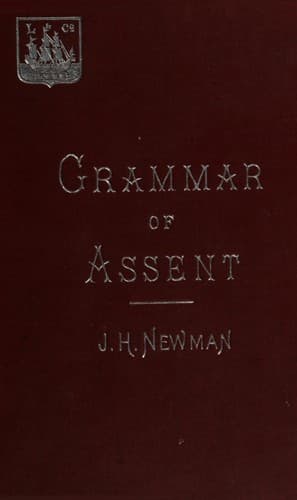
An Essay in Aid of a Grammar of AssentNewman, John Henry
Religion
An Essay in Aid of a Grammar of Assent
Newman, John Henry
Faith; Theism
We are now able to determine what a dogma of faith is, and what it is
to believe it. A dogma is a proposition; it stands for a notion or for
a thing; and to believe it is to give the assent of the mind to it, as
it stands for the one or for the other. To give a real assent to it is
an act of religion; to give a notional, is a theological act. It is
discerned, rested in, and appropriated as a reality, by the religious
imagination; it is held as a truth, by the theological intellect.
Not as if there were in fact, or could be, any line of demarcation
or party-wall between these two modes of assent, the religious
and the theological. As intellect is common to all men as well as
imagination, every religious man is to a certain extent a theologian,
and no theology can start or thrive without the initiative and abiding
presence of religion. As in matters of this world, sense, sensation,
instinct, intuition, supply us with facts, and the intellect uses
them; so, as regards our relations with the Supreme Being, we get our
facts from the witness, first of nature, then of revelation, and our
doctrines, in which they issue, through the exercise of abstraction and
inference. This is obvious; but it does not interfere with holding that
there is a theological habit of mind, and a religious, each distinct
from each, religion using theology, and theology using religion. This
being understood, I propose to consider the dogmas of the Being of a
God, and of the Divine Trinity in Unity, in their relation to assent,
both notional and real, and principally to real assent;—however, I have
not yet finished all I have to say by way of introduction.
Now first, my subject is assent, and not inference. I am not proposing
to set forth the arguments which issue in the belief of these
doctrines, but to investigate what it is to believe in them, what the
mind does, what it contemplates, when it makes an act of faith. It
is true that the same elementary facts which create an object for an
assent, also furnish matter for an inference: and in showing what we
believe, I shall unavoidably be in a measure showing why we believe;
but this is the very reason that makes it necessary for me at the
outset to insist on the real distinction between these two concurring
and coincident courses of thought, and to premise by way of caution,
lest I should be misunderstood, that I am not considering the question
that there is a God, but rather what God is.
Public-domain text, read in full here on John Shaqi.
Reviews
Reviews
No reviews yet
Be the first to share your thoughts on this work.
Elsewhere in the archive
Join the Discussion
Join the discussion
Sign in to leave a comment or review.
Sign InorCreate an account