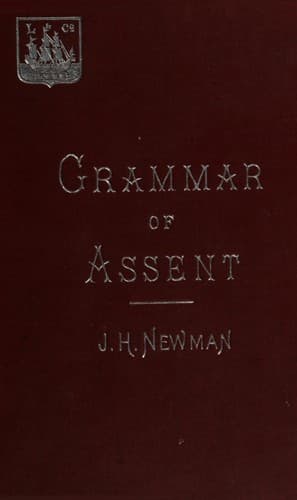
An Essay in Aid of a Grammar of AssentNewman, John Henry
Religion
An Essay in Aid of a Grammar of Assent
Newman, John Henry
Faith; Theism
“Let no one suppose, that in saying this I am maintaining that all
proofs are equally difficult, and all propositions equally debatable.
Some assumptions are greater than others, and some doctrines involve
postulates larger than others, and more numerous. I only say, that
impressions lead to action, and that reasonings lead from it. Knowledge
of premisses, and inferences upon them,—this is not to _live_. It is
very well as a matter of liberal curiosity and of philosophy to analyze
our modes of thought: but let this come second, and when there is
leisure for it, and then our examinations will in many ways even be
subservient to action. But if we commence with scientific knowledge
and argumentative proof, or lay any great stress upon it as the basis
of personal Christianity, or attempt to make man moral and religious
by libraries and museums, let us in consistency take chemists for our
cooks, and mineralogists for our masons.
“Now I wish to state all this as matter of fact, to be judged by the
candid testimony of any persons whatever. Why we are so constituted
that faith, not knowledge or argument, is our principle of action, is
a question with which I have nothing to do; but I think it is a fact,
and, if it be such, we must resign ourselves to it as best we may,
unless we take refuge in the intolerable paradox, that the mass of men
are created for nothing, and are meant to leave life as they entered it.
“So well has this practically been understood in all ages of the world,
that no religion yet has been a religion of physics or of philosophy.
It has ever been synonymous with revelation. It never has been a
deduction from what we know; it has ever been an assertion of what
we are to believe. It has never lived in a conclusion; it has ever
been a message, a history, or a vision. No legislator or priest ever
dreamed of educating our moral nature by science or by argument. There
is no difference here between true religions and pretended. Moses was
instructed not to reason from the creation, but to work miracles.
Christianity is a history supernatural, and almost scenic: it tells us
what its Author is, by telling us what He has done.
“Lord Brougham himself has recognized the force of this principle. He
has not left his philosophical religion to argument; he has committed
it to the keeping of the imagination. Why should he depict a great
republic of letters, and an intellectual pantheon, but that he feels
that instances and patterns, not logical reasonings, are the living
conclusions which alone have a hold over the affections or can form the
character?”
Chapter V. Apprehension And Assent In The Matter Of Religion.
Public-domain text, read in full here on John Shaqi.
Reviews
Reviews
No reviews yet
Be the first to share your thoughts on this work.
Elsewhere in the archive
Join the Discussion
Join the discussion
Sign in to leave a comment or review.
Sign InorCreate an account