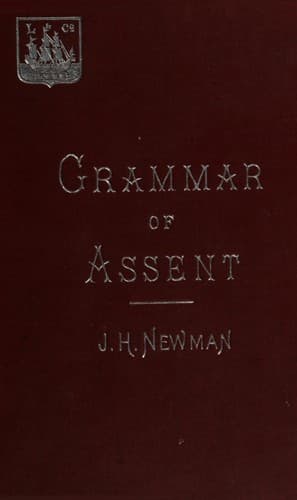
An Essay in Aid of a Grammar of AssentNewman, John Henry
Religion
An Essay in Aid of a Grammar of Assent
Newman, John Henry
Faith; Theism
Let us then thus consider conscience, not as a rule of right conduct,
but as a sanction of right conduct. This is its primary and most
authoritative aspect; it is the ordinary sense of the word. Half the
world would be puzzled to know what was meant by the moral sense; but
every one knows what is meant by a good or bad conscience. Conscience
is ever forcing on us by threats and by promises that we must follow
the right and avoid the wrong; so far it is one and the same in the
mind of every one, whatever be its particular errors in particular
minds as to the acts which it orders to be done or to be avoided; and
in this respect it corresponds to our perception of the beautiful and
deformed. As we have naturally a sense of the beautiful and graceful
in nature and art, though tastes proverbially differ, so we have a
sense of duty and obligation, whether we all associate it with the
same certain actions in particular or not. Here, however, Taste and
Conscience part company: for the sense of beautifulness, as indeed the
Moral Sense, has no special relations to persons, but contemplates
objects in themselves; conscience, on the other hand, is concerned with
persons primarily, and with actions mainly as viewed in their doers,
or rather with self alone and one’s own actions, and with others only
indirectly and as if in association with self. And further, taste is
its own evidence, appealing to nothing beyond its own sense of the
beautiful or the ugly, and enjoying the specimens of the beautiful
simply for their own sake; but conscience does not repose on itself,
but vaguely reaches forward to something beyond self, and dimly
discerns a sanction higher than self for its decisions, as is evidenced
in that keen sense of obligation and responsibility which informs them.
And hence it is that we are accustomed to speak of conscience as a
voice,—a term which we should never think of applying to the sense of
the beautiful; and moreover a voice, or the echo of a voice, imperative
and constraining, like no other dictate in the whole of our experience.
Public-domain text, read in full here on John Shaqi.
Reviews
Reviews
No reviews yet
Be the first to share your thoughts on this work.
Elsewhere in the archive
Join the Discussion
Join the discussion
Sign in to leave a comment or review.
Sign InorCreate an account