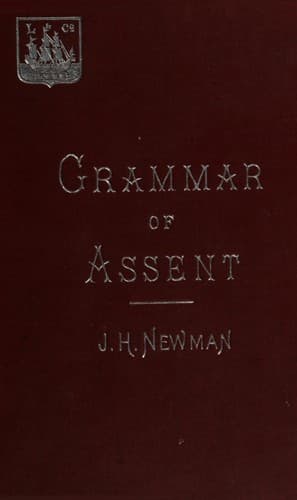
An Essay in Aid of a Grammar of AssentNewman, John Henry
Religion
An Essay in Aid of a Grammar of Assent
Newman, John Henry
Faith; Theism
And again, in consequence of this prerogative of dictating and
commanding, which is of its essence, Conscience has an intimate
bearing on our affections and emotions, leading us to reverence and
awe, hope and fear, especially fear, a feeling which is foreign for
the most part, not only to Taste, but even to the Moral Sense, except
in consequence of accidental associations. No fear is felt by any one
who recognizes that his conduct has not been beautiful, though he may
be mortified at himself, if perhaps he has thereby forfeited some
advantage; but, if he has been betrayed into any kind of immorality,
he has a lively sense of responsibility and guilt, though the act
be no offence against society,—of distress and apprehension, even
though it may be of present service to him,—of compunction and
regret, though in itself it be most pleasurable,—of confusion of
face, though it may have no witnesses. These various perturbations of
mind, which are characteristic of a bad conscience, and may be very
considerable,—self-reproach, poignant shame, haunting remorse, chill
dismay at the prospect of the future,—and their contraries, when the
conscience is good, as real though less forcible, self-approval, inward
peace, lightness of heart, and the like,—these emotions constitute
a specific difference between conscience and our other intellectual
senses,—common sense, good sense, sense of expedience, taste, sense
of honour, and the like,—as indeed they would also constitute
between conscience and the moral sense, supposing these two were not
aspects of one and the same feeling, exercised upon one and the same
subject-matter.
Public-domain text, read in full here on John Shaqi.
Reviews
Reviews
No reviews yet
Be the first to share your thoughts on this work.
Elsewhere in the archive
Join the Discussion
Join the discussion
Sign in to leave a comment or review.
Sign InorCreate an account