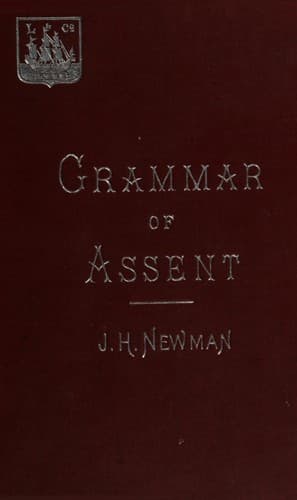
An Essay in Aid of a Grammar of AssentNewman, John Henry
Religion
An Essay in Aid of a Grammar of Assent
Newman, John Henry
Faith; Theism
And let me here refer again to the fact, to which I have already drawn
attention, that this instinct of the mind recognizing an external
Master in the dictate of conscience, and imaging the thought of Him
in the definite impressions which conscience creates, is parallel to
that other law of, not only human, but of brute nature, by which the
presence of unseen individual beings is discerned under the shifting
shapes and colours of the visible world. Is it by sense, or by reason,
that brutes understand the real unities, material and spiritual, which
are signified by the lights and shadows, the brilliant ever-changing
calidoscope, as it may be called, which plays upon their _retina_? Not
by reason, for they have not reason; not by sense, because they are
transcending sense; therefore it is an instinct. This faculty on the
part of brutes, unless we were used to it, would strike us as a great
mystery. It is one peculiarity of animal natures to be susceptible of
phenomena through the channels of sense; it is another to have in those
sensible phenomena a perception of the individuals to which this or
that group of them belongs. This perception of individual things, amid
the maze of shapes and colours which meets their sight, is given to
brutes in large measures, and that, apparently from the moment of their
birth. It is by no mere physical instinct, such as that which leads him
to his mother for milk, that the new-dropped lamb recognizes each of
his fellow lambkins as a whole, consisting of many parts bound up in
one, and, before he is an hour old, makes experience of his and their
rival individualities. And much more distinctly do the horse and dog
recognize even the personality of their masters. How are we to explain
this apprehension of things, which are one and individual, in the midst
of a world of pluralities and transmutations, whether in the instance
of brutes or again of children? But until we account for the knowledge
which an infant has of his mother or his nurse, what reason have we
to take exception at the doctrine, as strange and difficult, that in
the dictate of conscience, without previous experiences or analogical
reasoning, he is able gradually to perceive the voice, or the echoes of
the voice, of a Master, living, personal, and sovereign?
Public-domain text, read in full here on John Shaqi.
Reviews
Reviews
No reviews yet
Be the first to share your thoughts on this work.
Elsewhere in the archive
Join the Discussion
Join the discussion
Sign in to leave a comment or review.
Sign InorCreate an account