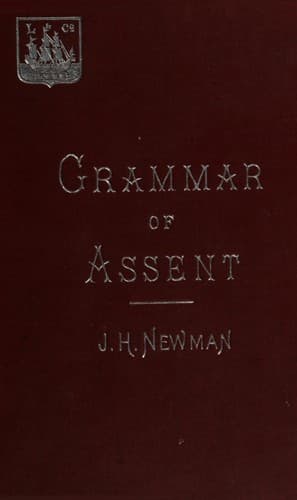
An Essay in Aid of a Grammar of AssentNewman, John Henry
Religion
An Essay in Aid of a Grammar of Assent
Newman, John Henry
Faith; Theism
deficient either in the religious sense or in their memory of early
years, than that they never had at all what those around them without
hesitation profess to have received from nature.
‐‐‐‐‐‐‐‐‐‐‐‐‐‐‐‐‐‐‐‐‐‐‐‐‐‐‐‐‐‐‐‐‐‐‐‐‐
So much on the doctrine of the Being and Attributes of God, and of
the real apprehension with which we can contemplate and assent to
it:—now I turn to the doctrine of the Holy Trinity, with the purpose of
investigating in like manner how far it belongs to theology, how far
to the faith and devotion of the individual; how far the propositions
enunciating it are confined to the expression of intellectual notions,
and how far they stand for things also, and admit of that assent which
we give to objects presented to us by the imagination. And first I have
to state what our doctrine is.
No one is to be called a Theist, who does not believe in a Personal
God, whatever difficulty there may be in defining the word “Personal.”
Now it is the belief of Catholics about the Supreme Being, that
this essential characteristic of His Nature is reiterated in three
distinct ways or modes; so that the Almighty God, instead of being
One Person only, which is the teaching of Natural Religion, has Three
Personalities, and is at once, according as we view Him in the one or
the other of them, the Father, the Son, and the Spirit—a Divine Three,
who bear towards Each Other the several relations which those names
indicate, and are in that respect distinct from Each Other, and in that
alone.
This is the teaching of the Athanasian Creed; viz. that the One
Personal God, who is not a logical or physical unity, but a Living
_Monas_, more really one even than an individual man is one—He
(“unus,” not “unum,” because of the inseparability of His Nature and
Personality),—He at once is Father, is Son, is Holy Ghost, Each of whom
is that One Personal God in the fulness of His Being and Attributes; so
that the Father is all that is meant by the word “God,” as if we knew
nothing of Son, or of Spirit; and in like manner the Son and the Spirit
are Each by Himself all that is meant by the word, as if the Other Two
were unknown; moreover, that by the word “God” is meant nothing over
and above what is meant by the “Father,” or by “the Son,” or by “the
Holy Ghost;” and that the Father is in no sense the Son, nor the Son
the Holy Ghost, nor the Holy Ghost the Father. Such is the prerogative
of the Divine Infinitude, that that One and Single Personal Being, the
Almighty God, is really Three, while He is absolutely One.
Public-domain text, read in full here on John Shaqi.
Reviews
Reviews
No reviews yet
Be the first to share your thoughts on this work.
Elsewhere in the archive
Join the Discussion
Join the discussion
Sign in to leave a comment or review.
Sign InorCreate an account