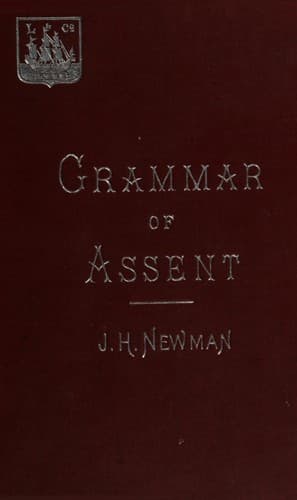
An Essay in Aid of a Grammar of AssentNewman, John Henry
Religion
An Essay in Aid of a Grammar of Assent
Newman, John Henry
Faith; Theism
I begin my answer to this objection by recurring to what has already
been said concerning the relation of theology with its notional
propositions to religious and devotional assent. Devotion is excited
doubtless by the plain, categorical truths of revelation, such as the
articles of the Creed; on these it depends; with these it is satisfied.
It accepts them one by one; it is careless about intellectual
consistency; it draws from each of them the spiritual nourishment which
it was intended to supply. Far different, certainly, is the nature and
duty of the intellect. It is ever active, inquisitive, penetrating;
it examines doctrine and doctrine; it compares, contrasts, and forms
them into a science; that science is theology. Now theological
science, being thus the exercise of the intellect upon the _credenda_
of revelation, is, though not directly devotional, at once natural,
excellent, and necessary. It is natural, because the intellect is one
of our highest faculties; excellent, because it is our duty to use
our faculties to the full; necessary, because, unless we apply our
intellect to revealed truth rightly, others will exercise their minds
upon it wrongly. Accordingly, the Catholic intellect makes a survey
and a catalogue of the doctrines contained in the _depositum_ of
revelation, as committed to the Church’s keeping; it locates, adjusts,
defines them each, and brings them together into a whole. Moreover,
it takes particular aspects or portions of them; it analyzes them,
whether into first principles really such, or into hypotheses of an
illustrative character. It forms generalizations, and gives names to
them. All these deductions are true, if rightly deduced, because they
are deduced from what is true; and therefore in one sense they are a
portion of the _depositum_ of faith or _credenda_, while in another
sense they are additions to it: however, additions or not, they have,
I readily grant, the characteristic disadvantage of being abstract and
notional statements.
Nor is this all: error gives opportunity to many more additions than
truth. There is another set of deductions, inevitable also, and also
part or not part of the revealed _credenda_, according as we please
to view them. If a proposition is true, its contradictory is false.
If then a man believes that Christ is God, he believes also, and that
necessarily, that to say He is not God is false, and that those who
so say are in error. Here then again the prospect opens upon us of a
countless multitude of propositions, which in their first elements
are close upon devotional truth,—of groups of propositions, and those
groups divergent, independent, ever springing into life with an
inexhaustible fecundity, according to the ever-germinating forms of
heresy, of which they are the antagonists. These too have their place
in theological science.
Public-domain text, read in full here on John Shaqi.
Reviews
Reviews
No reviews yet
Be the first to share your thoughts on this work.
Elsewhere in the archive
Join the Discussion
Join the discussion
Sign in to leave a comment or review.
Sign InorCreate an account