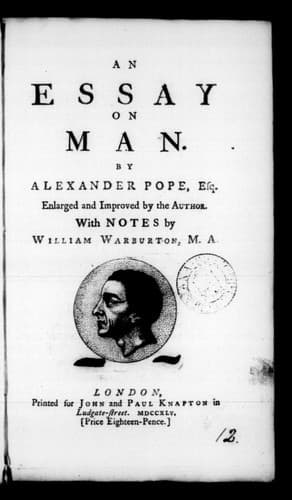
An Essay on Man; Moral Essays and SatiresPope, Alexander
ReligionComparative
An Essay on Man; Moral Essays and Satires
Pope, Alexander
English poetry -- 18th century
First strip off all her equipage of pride;
Deduct what is but vanity or dress,
Or learning's luxury, or idleness;
Or tricks to show the stretch of human brain,
Mere curious pleasure, or ingenious pain;
Expunge the whole, or lop th' excrescent parts
Of all our vices have created arts;
Then see how little the remaining sum,
Which served the past, and must the times to come!
II. Two principles in human nature reign;
Self-love to urge, and reason, to restrain;
Nor this a good, nor that a bad we call,
Each works its end, to move or govern all
And to their proper operation still,
Ascribe all good; to their improper, ill.
Self-love, the spring of motion, acts the soul;
Reason's comparing balance rules the whole.
Man, but for that, no action could attend,
And but for this, were active to no end:
Fixed like a plant on his peculiar spot,
To draw nutrition, propagate, and rot;
Or, meteor-like, flame lawless through the void,
Destroying others, by himself destroyed.
Most strength the moving principle requires;
Active its task, it prompts, impels, inspires.
Sedate and quiet the comparing lies,
Formed but to check, deliberate, and advise.
Self-love still stronger, as its objects nigh;
Reason's at distance, and in prospect lie:
That sees immediate good by present sense;
Reason, the future and the consequence.
Thicker than arguments, temptations throng.
At best more watchful this, but that more strong.
The action of the stronger to suspend,
Reason still use, to reason still attend.
Attention, habit and experience gains;
Each strengthens reason, and self-love restrains.
Let subtle schoolmen teach these friends to fight,
More studious to divide than to unite;
And grace and virtue, sense and reason split,
With all the rash dexterity of wit.
Wits, just like fools, at war about a name,
Have full as oft no meaning, or the same.
Self-love and reason to one end aspire,
Pain their aversion, pleasure their desire;
But greedy that, its object would devour,
This taste the honey, and not wound the flower:
Pleasure, or wrong or rightly understood,
Our greatest evil, or our greatest good.
Public-domain text, read in full here on John Shaqi.
Reviews
Reviews
No reviews yet
Be the first to share your thoughts on this work.
Join the Discussion
Join the discussion
Sign in to leave a comment or review.
Sign InorCreate an account