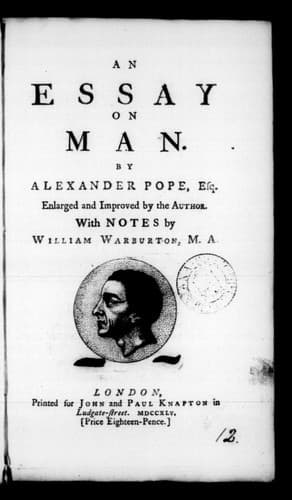
An Essay on Man; Moral Essays and SatiresPope, Alexander
ReligionComparative
An Essay on Man; Moral Essays and Satires
Pope, Alexander
English poetry -- 18th century
The frugal crone, whom praying priests attend,
Still tries to save the hallowed taper's end,
Collects her breath, as ebbing life retires,
For one puff more, and in that puff expires.
"Odious! in woollen! 'twould a saint provoke"
(Were the last words that poor Narcissa spoke);
"No, let a charming chintz, and Brussels lace
Wrap my cold limbs, and shade my lifeless face:
One would not, sure, be frightful when one's dead--
And--Betty--give this cheek a little red."
The courtier smooth, who forty years had shined
An humble servant to all human kind,
Just brought out this, when scarce his tongue could stir,
"If--where I'm going--I could serve you, sir?"
"I give and I devise" (old Euclio said,
And sighed) "my lands and tenements to Ned."
"Your money, sir?" "My money, sir? what, all?
Why--if I must" (then wept)--"I give it Paul."
"The Manor, sir?"--"The Manor! hold," he cried,
"Not that,--I cannot part with that"--and died.
And you! brave Cobham, to the latest breath
Shall feel your ruling passion strong in death:
Such in those moments as in all the past,
"Oh, save my country, Heaven!" shall be your last.
EPISTLE II. TO A LADY.
Of the Characters of Women.
Nothing so true as what you once let fall,
"Most women have no characters at all."
Matter too soft a lasting mark to bear,
And best distinguished by black, brown, or fair.
How many pictures of one nymph we view,
All how unlike each other, all how true!
Arcadia's countess, here, in ermined pride,
Is, there, Pastora by a fountain side.
Here Fannia, leering on her own good man,
And there, a naked Leda with a swan.
Let then the fair one beautifully cry,
In Magdalen's loose hair, and lifted eye,
Or dressed in smiles of sweet Cecilia shine,
With simpering angels, palms, and harps divine;
Whether the charmer sinner it, or saint it,
If folly grow romantic, I must paint it.
Come then, the colours and the ground prepare!
Dip in the rainbow, trick her off in air;
Choose a firm cloud, before it fall, and in it
Catch, ere she change, the Cynthia of this minute.
Rufa, whose eye, quick-glancing o'er the park
Attracts each light gay meteor of a spark,
Agrees as ill with Rufa studying Locke,
As Sappho's diamonds with her dirty smock;
Or Sappho at her toilet's greasy task,
With Sappho fragrant at an evening masque:
So morning insects that in muck begun,
Shine, buzz, and fly-blow in the setting sun.
How soft is Silia! fearful to offend;
The frail one's advocate, the weak one's friend:
To her, Calista proved her conduct nice;
And good Simplicius asks of her advice.
Sudden, she storms! she raves! You tip the wink,
But spare your censure; Silia does not drink.
All eyes may see from what the change arose,
All eyes may see--a pimple on her nose.
Papillia, wedded to her am'rous spark,
Sighs for the shades--"How charming is a park!"
A park is purchased, but the fair he sees
All bathed in tears--"Oh, odious, odious trees!"
Public-domain text, read in full here on John Shaqi.
Reviews
Reviews
No reviews yet
Be the first to share your thoughts on this work.
Join the Discussion
Join the discussion
Sign in to leave a comment or review.
Sign InorCreate an account