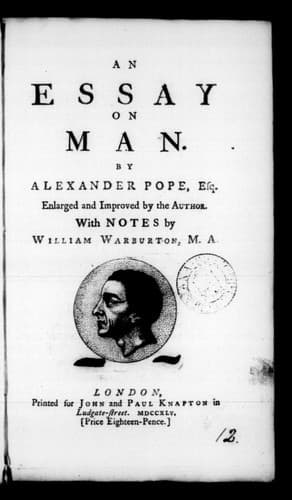
An Essay on Man; Moral Essays and SatiresPope, Alexander
ReligionComparative
An Essay on Man; Moral Essays and Satires
Pope, Alexander
English poetry -- 18th century
That it is known to few, most falling into one of the extremes, Avarice
or Profusion, v.1, etc. The point discussed, whether the invention of
money has been more commodious or pernicious to Mankind, v.21 to 77. That
Riches, either to the Avaricious or the Prodigal, cannot afford
Happiness, scarcely Necessaries, v.89-160. That Avarice is an absolute
Frenzy, without an end or purpose, v.113, etc., 152. Conjectures about
the motives of Avaricious men, v.121 to 153. That the conduct of men,
with respect to Riches, can only be accounted for by the Order of
Providence, which works the general good out of extremes, and brings all
to its great End by perpetual Revolutions, v.161 to 178. How a Miser
acts upon Principles which appear to him reasonable, v.179. How a
Prodigal does the same, v.199. The due Medium and true use of Riches,
v.219. The Man of Ross, v.250. The fate of the Profuse and the
Covetous, in two examples; both miserable in Life and in Death, v.300,
etc. The Story of Sir Balaam, v.339 to the end.
P. Who shall decide, when doctors disagree,
And soundest casuists doubt, like you and me?
You hold the word, from Jove to Momus given,
That man was made the standing jest of Heaven;
And gold but sent to keep the fools in play,
For some to heap, and some to throw away.
But I, who think more highly of our kind,
(And surely, Heaven and I are of a mind)
Opine, that Nature, as in duty bound,
Deep hid the shining mischief under ground:
But when by man's audacious labour won,
Flamed forth this rival to its sire, the sun,
Then careful Heaven supplied two sorts of men,
To squander these, and those to hide again.
Like doctors thus, when much dispute has past,
We find our tenets just the same at last.
Both fairly owning Riches, in effect,
No grace of Heaven or token of th' elect;
Given to the fool, the mad, the vain, the evil,
To Ward, to Waters, Chartres, and the devil.
B. What Nature wants, commodious gold bestows,
'Tis thus we eat the bread another sows.
P. But how unequal it bestows, observe;
'Tis thus we riot, while, who sow it, starve:
What Nature wants (a phrase I much distrust)
Extends to luxury, extends to lust:
Useful, I grant, it serves what life requires,
But, dreadful too, the dark assassin hires.
B. Trade it may help, society extend.
P. But lures the pirate, and corrupts the friend.
B. It raises armies in a nation's aid.
P. But bribes a senate, and the land's betrayed.
In vain may heroes fight, and patriots rave;
If secret gold sap on from knave to knave.
Once, we confess, beneath the patriot's cloak,
From the cracked bag the dropping guinea spoke,
And jingling down the back-stairs, told the crew,
"Old Cato is as great a rogue as you."
Blest paper-credit! last and best supply!
That lends corruption lighter wings to fly!
Gold imped by thee can compass hardest things,
Can pocket states, can fetch or carry kings;
A single leaf shall waft an army o'er,
Or ship off senates to a distant shore;
Public-domain text, read in full here on John Shaqi.
Reviews
Reviews
No reviews yet
Be the first to share your thoughts on this work.
Join the Discussion
Join the discussion
Sign in to leave a comment or review.
Sign InorCreate an account