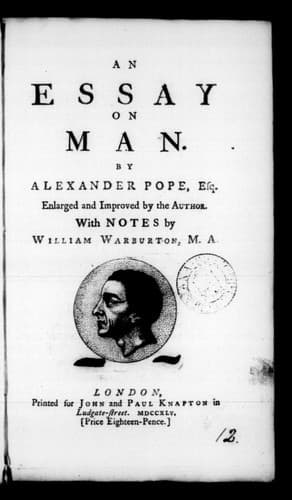
An Essay on Man; Moral Essays and SatiresPope, Alexander
ReligionComparative
An Essay on Man; Moral Essays and Satires
Pope, Alexander
English poetry -- 18th century
The Reflections of Horace, and the Judgments past in his Epistle to
Augustus, seemed so seasonable to the present Times, that I could not
help applying them to the use of my own Country. The Author thought them
considerable enough to address them to his Prince; whom he paints with
all the great and good qualities of a Monarch, upon whom the Romans
depended for the Increase of an Absolute Empire. But to make the Poem
entirely English, I was willing to add one or two of those which
contribute to the Happiness of a Free People, and are more consistent
with the Welfare of our Neighbours.
This Epistle will show the learned World to have fallen into Two
mistakes: one, that Augustus was a Patron of Poets in general; whereas he
not only prohibited all but the Best Writers to name him, but recommended
that Care even to the Civil Magistrate: Admonebat Praetores, ne
paterentur Nomen suum obsolefieri, etc. The other, that this Piece was
only a general Discourse of Poetry; whereas it was an Apology for the
Poets, in order to render Augustus more their Patron. Horace here pleads
the Cause of his Contemporaries, first against the Taste of the Town,
whose humour it was to magnify the Authors of the preceding Age; secondly
against the Court and Nobility, who encouraged only the Writers for the
Theatre; and lastly against the Emperor himself, who had conceived them
of little Use to the Government. He shows (by a View of the Progress of
Learning, and the Change of Taste among the Romans) that the Introduction
of the Polite Arts of Greece had given the Writers of his Time great
advantages over their Predecessors; that their Morals were much improved,
and the Licence of those ancient Poets restrained: that Satire and Comedy
were become more just and useful; that, whatever extravagances were left
on the Stage, were owing to the Ill Taste of the Nobility; that Poets,
under due Regulations, were in many respects useful to the State, and
concludes, that it was upon them the Emperor himself must depend for his
Fame with Posterity.
We may farther learn from this Epistle, that Horace made his Court to
this great Prince by writing with a decent Freedom toward him, with a
just Contempt of his low Flatterers, and with a manly Regard to his own
Character. P.
EPISTLE I. TO AUGUSTUS.
Public-domain text, read in full here on John Shaqi.
Reviews
Reviews
No reviews yet
Be the first to share your thoughts on this work.
Elsewhere in the archive
Join the Discussion
Join the discussion
Sign in to leave a comment or review.
Sign InorCreate an account