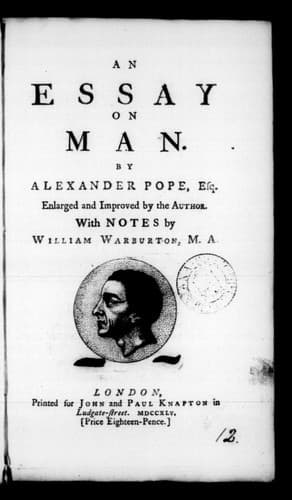
An Essay on Man; Moral Essays and SatiresPope, Alexander
ReligionComparative
An Essay on Man; Moral Essays and Satires
Pope, Alexander
English poetry -- 18th century
While you, great patron of mankind! sustain
The balanced world, and open all the main;
Your country, chief, in arms abroad defend,
At home, with morals, arts, and laws amend;
How shall the muse from such a monarch, steal
An hour, and not defraud the public weal?
Edward and Henry, now the boast of fame,
And virtuous Alfred, a more sacred name,
After a life of generous toils endured,
The Gaul subdued, or property secured,
Ambition humbled, mighty cities stormed,
Our laws established, and the world reformed;
Closed their long glories with a sigh, to find
Th' unwilling gratitude of base mankind!
All human virtue, to its latest breath,
Finds envy never conquered but by death.
The great Alcides, every labour past,
Had still this monster to subdue at last.
Sure fate of all, beneath whose rising ray
Each star of meaner merit fades away!
Oppressed we feel the beam directly beat,
Those suns of glory please not till they set.
To thee, the world its present homage pays,
The harvest early, but mature the praise:
Great friend of liberty! in kings a name
Above all Greek, above all Roman fame:
Whose word is truth, as sacred and revered,
As heaven's own oracles from altars heard.
Wonder of kings! like whom, to mortal eyes
None e'er has risen, and none e'er shall rise.
Just in one instance be it yet confest
Your people, sir, are partial in the rest:
Foes to all living worth except your own,
And advocates for folly dead and gone.
Authors, like coins, grow dear as they grow old;
It is the rust we value, not the gold.
Chaucer's worst ribaldry is learned by rote,
And beastly Skelton heads of houses quote:
One likes no language but the Faery Queen;
A Scot will fight for Christ's Kirk o' the Green:
And each true Briton is to Ben so civil,
He swears the Muses met him at the devil.
Though justly Greece her eldest sons admires,
Why should not we be wiser than our sires?
In every public virtue we excel;
We build, we paint, we sing, we dance as well,
And learned Athens to our art must stoop,
Could she behold us tumbling through a hoop.
If time improve our wit as well as wine,
Say at what age a poet grows divine?
Shall we or shall we not account him so,
Who died, perhaps, a hundred years ago?
End all dispute; and fix the year precise
When British bards begin t' immortalise?
"Who lasts a century can have no flaw,
I hold that wit a classic, good in law."
Suppose he wants a year, will you compound;
And shall we deem him ancient, right and sound,
Or damn to all eternity at once,
At ninety-nine, a modern and a dunce?
"We shall not quarrel for a year or two;
By courtesy of England, he may do."
Then by the rule that made the horse-tail bear,
I pluck out year by year, as hair by hair,
And melt down ancients like a heap of snow:
While you to measure merits, look in Stowe,
And estimating authors by the year
Bestow a garland only on a bier.
Shakespeare (whom you and every play-house bill
Style the divine, the matchless, what you will)
Public-domain text, read in full here on John Shaqi.
Reviews
Reviews
No reviews yet
Be the first to share your thoughts on this work.
Elsewhere in the archive
Join the Discussion
Join the discussion
Sign in to leave a comment or review.
Sign InorCreate an account