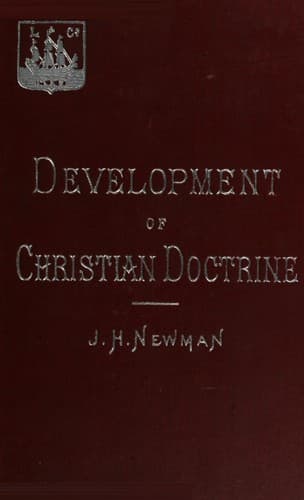
An Essay on the Development of Christian DoctrineNewman, John Henry
Religion
An Essay on the Development of Christian Doctrine
Newman, John Henry
Catholic Church -- Doctrines; Dogma, Development of
And coincident with these changes, a most remarkable result is
discovered. The Catholic polemic, in view of the Arian and Monophysite
errors, being of this character, became the natural introduction to the
_cultus Sanctorum_; for in proportion as texts descriptive of created
mediation ceased to belong to our Lord, so was a room opened for created
mediators. Nay, as regards the instance of Angelic appearances itself,
as St. Augustine explained them, if those appearances were creatures,
certainly creatures were worshipped by the Patriarchs, not indeed in
themselves,[138:1] but as the token of a Presence greater than
themselves. When "Moses hid his face, for he was afraid to look upon
God," he hid his face before a creature; when Jacob said, "I have seen
God face to face and my life is preserved," the Son of God was there,
but what he saw, what he wrestled with, was an Angel. When "Joshua fell
on his face to the earth and did worship before the captain of the
Lord's host, and said unto him, What saith my Lord unto his servant?"
what was seen and heard was a glorified creature, if St. Augustine is
to be followed; and the Son of God was in him.
And there were plain precedents in the Old Testament for the lawfulness
of such adoration. When "the people saw the cloudy pillar stand at the
tabernacle-door," "all the people rose up and worshipped, every man in
his tent-door."[139:1] When Daniel too saw "a certain man clothed in
linen" "there remained no strength" in him, for his "comeliness was
turned" in him "into corruption." He fell down on his face, and next
remained on his knees and hands, and at length "stood trembling," and
said "O my Lord, by the vision my sorrows are turned upon me, and I have
retained no strength. For how can the servant of this my Lord talk with
this my Lord?"[139:2] It might be objected perhaps to this argument,
that a worship which was allowable in an elementary system might be
unlawful when "grace and truth" had come "through Jesus Christ;" but
then it might be retorted surely, that that elementary system had been
emphatically opposed to all idolatry, and had been minutely jealous of
everything which might approach to favouring it. Nay, the very
prominence given in the Pentateuch to the doctrine of a Creator, and the
comparative silence concerning the Angelic creation, and the prominence
given to the Angelic creation in the later Prophets, taken together,
were a token both of that jealousy, and of its cessation, as time went
on. Nor can anything be concluded from St. Paul's censure of Angel
worship, since the sin which he is denouncing was that of "not holding
the Head," and of worshipping creatures _instead_ of the Creator as the
source of good. The same explanation avails for passages like those in
St. Athanasius and Theodoret, in which the worship of Angels is
discountenanced.
6.
Public-domain text, read in full here on John Shaqi.
Reviews
Reviews
No reviews yet
Be the first to share your thoughts on this work.
Elsewhere in the archive
Join the Discussion
Join the discussion
Sign in to leave a comment or review.
Sign InorCreate an account