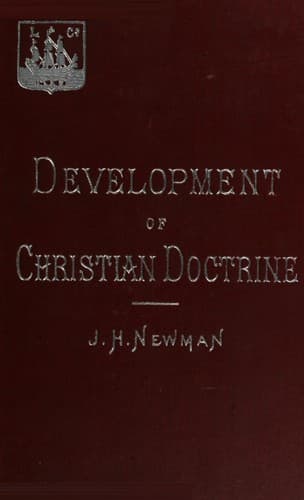
An Essay on the Development of Christian DoctrineNewman, John Henry
Religion
An Essay on the Development of Christian Doctrine
Newman, John Henry
Catholic Church -- Doctrines; Dogma, Development of
The Arian controversy had led to another development, which confirmed by
anticipation the _cultus_ to which St. Augustine's doctrine pointed. In
answer to the objection urged against our Lord's supreme Divinity from
texts which speak of His exaltation, St. Athanasius is led to insist
forcibly on the benefits which have accrued to man through it. He says
that, in truth, not Christ, but that human nature which He had assumed,
was raised and glorified in Him. The more plausible was the heretical
argument against His Divinity from those texts, the more emphatic is St.
Athanasius's exaltation of our regenerate nature by way of explaining
them. But intimate indeed must be the connexion between Christ and His
brethren, and high their glory, if the language which seemed to belong
to the Incarnate Word really belonged to them. Thus the pressure of the
controversy elicited and developed a truth, which till then was held
indeed by Christians, but less perfectly realized and not publicly
recognized. The sanctification, or rather the deification of the nature
of man, is one main subject of St. Athanasius's theology. Christ, in
rising, raises His Saints with Him to the right hand of power. They
become instinct with His life, of one body with His flesh, divine sons,
immortal kings, gods. He is in them, because He is in human nature; and
He communicates to them that nature, deified by becoming His, that them
It may deify. He is in them by the Presence of His Spirit, and in them
He is seen. They have those titles of honour by participation, which are
properly His. Without misgiving we may apply to them the most sacred
language of Psalmists and Prophets. "Thou art a Priest for ever" may be
said of St. Polycarp or St. Martin as well as of their Lord. "He hath
dispersed abroad, he hath given to the poor," was fulfilled in St.
Laurence. "I have found David My servant," first said typically of the
King of Israel, and belonging really to Christ, is transferred back
again by grace to His Vicegerents upon earth. "I have given thee the
nations for thine inheritance" is the prerogative of Popes; "Thou hast
given him his heart's desire," the record of a martyr; "thou hast loved
righteousness and hated iniquity," the praise of Virgins.
7.
Public-domain text, read in full here on John Shaqi.
Reviews
Reviews
No reviews yet
Be the first to share your thoughts on this work.
Elsewhere in the archive
Join the Discussion
Join the discussion
Sign in to leave a comment or review.
Sign InorCreate an account