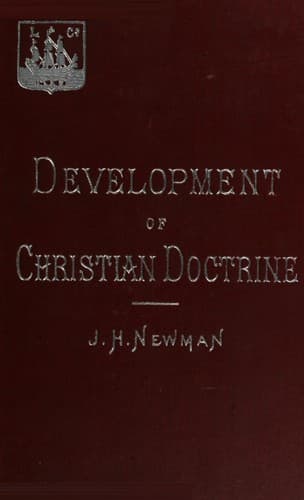
An Essay on the Development of Christian DoctrineNewman, John Henry
Religion
An Essay on the Development of Christian Doctrine
Newman, John Henry
Catholic Church -- Doctrines; Dogma, Development of
Again: "Whereas no point avowed by Christians could be so apt to raise
offence and jealousy in pagans against our religion as this, which
setteth up a power of so vast extent and huge influence; whereas no
novelty could be more surprising or startling than the creation of an
universal empire over the consciences and religious practices of men;
whereas also this doctrine could not be but very conspicuous and glaring
in ordinary practice, it is prodigious that all pagans should not loudly
exclaim against it," that is, on the supposition that the Papal power
really was then in actual exercise.
And again: "It is most prodigious that, in the disputes managed by the
Fathers against heretics, the Gnostics, Valentinians, &c., they should
not, even in the first place, allege and urge the sentence of the
universal pastor and judge, as a most evidently conclusive argument, as
the most efficacious and compendious method of convincing and silencing
them."
Once more: "Even Popes themselves have shifted their pretences, and
varied in style, according to the different circumstances of time, and
their variety of humours, designs, interests. In time of prosperity, and
upon advantage, when they might safely do it, any Pope almost would talk
high and assume much to himself; but when they were low, or stood in
fear of powerful contradiction, even the boldest Popes would speak
submissively or moderately."[153:1]
On the whole, supposing the power to be divinely bestowed, yet in the
first instance more or less dormant, a history could not be traced out
more probable, more suitable to that hypothesis, than the actual course
of the controversy which took place age after age upon the Papal
supremacy.
7.
It will be said that all this is a theory. Certainly it is: it is a
theory to account for facts as they lie in the history, to account for
so much being told us about the Papal authority in early times, and not
more; a theory to reconcile what is and what is not recorded about it;
and, which is the principal point, a theory to connect the words and
acts of the Ante-nicene Church with that antecedent probability of a
monarchical principle in the Divine Scheme, and that actual
exemplification of it in the fourth century, which forms their
presumptive interpretation. All depends on the strength of that
presumption. Supposing there be otherwise good reason for saying that
the Papal Supremacy is part of Christianity, there is nothing in the
early history of the Church to contradict it.
8.
Public-domain text, read in full here on John Shaqi.
Reviews
Reviews
No reviews yet
Be the first to share your thoughts on this work.
Elsewhere in the archive
Join the Discussion
Join the discussion
Sign in to leave a comment or review.
Sign InorCreate an account