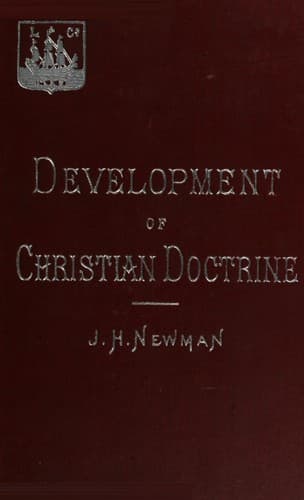
An Essay on the Development of Christian DoctrineNewman, John Henry
Religion
An Essay on the Development of Christian Doctrine
Newman, John Henry
Catholic Church -- Doctrines; Dogma, Development of
This is but one out of many instances with which the history of the
Church supplies us. The fortunes of a theological school are made, in a
later generation, the measure of the teaching of its founder. The great
Origen after his many labours died in peace; his immediate pupils were
saints and rulers in the Church; he has the praise of St. Athanasius,
St. Basil, and St. Gregory Nazianzen, and furnishes materials to St.
Ambrose and St. Hilary; yet, as time proceeded, a definite heterodoxy
was the growing result of his theology, and at length, three hundred
years after his death, he was condemned, and, as has generally been
considered, in an Ecumenical Council.[194:1] "Diodorus of Tarsus," says
Tillemont, "died at an advanced age, in the peace of the Church,
honoured by the praises of the greatest saints, and crowned with a
glory, which, having ever attended him through life, followed him after
his death;"[194:2] yet St. Cyril of Alexandria considers him and
Theodore of Mopsuestia the true authors of Nestorianism, and he was
placed in the event by the Nestorians among their saints. Theodore
himself was condemned after his death by the same Council which is said
to have condemned Origen, and is justly considered the chief
rationalizing doctor of Antiquity; yet he was in the highest repute in
his day, and the Eastern Synod complains, as quoted by Facundus, that
"Blessed Theodore, who died so happily, who was so eminent a teacher for
five and forty years, and overthrew every heresy, and in his lifetime
experienced no imputation from the orthodox, now after his death so
long ago, after his many conflicts, after his ten thousand books
composed in refutation of errors, after his approval in the sight of
priests, emperors, and people, runs the risk of receiving the reward of
heretics, and of being called their chief."[195:1] There is a certain
continuous advance and determinate path which belong to the history of a
doctrine, policy, or institution, and which impress upon the common
sense of mankind, that what it ultimately becomes is the issue of what
it was at first. This sentiment is expressed in the proverb, not limited
to Latin, _Exitus acta probat_; and is sanctioned by Divine wisdom,
when, warning us against false prophets, it says, "Ye shall know them by
their fruits."
A doctrine, then, professed in its mature years by a philosophy or
religion, is likely to be a true development, not a corruption, in
proportion as it seems to be the _logical issue_ of its original
teaching.
SECTION V.
FIFTH NOTE. ANTICIPATION OF ITS FUTURE.
Public-domain text, read in full here on John Shaqi.
Reviews
Reviews
No reviews yet
Be the first to share your thoughts on this work.
Elsewhere in the archive
Join the Discussion
Join the discussion
Sign in to leave a comment or review.
Sign InorCreate an account