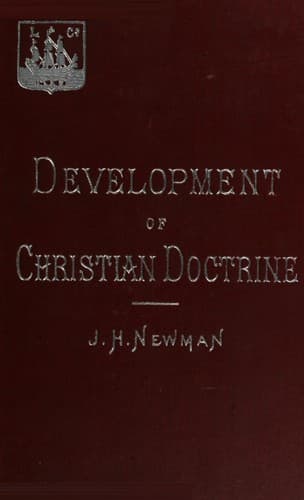
An Essay on the Development of Christian DoctrineNewman, John Henry
Religion
An Essay on the Development of Christian Doctrine
Newman, John Henry
Catholic Church -- Doctrines; Dogma, Development of
Since, when an idea is living, that is, influential and effective, it is
sure to develope according to its own nature, and the tendencies, which
are carried out on the long run, may under favourable circumstances show
themselves early as well as late, and logic is the same in all ages,
instances of a development which is to come, though vague and isolated,
may occur from the very first, though a lapse of time be necessary to
bring them to perfection. And since developments are in great measure
only aspects of the idea from which they proceed, and all of them are
natural consequences of it, it is often a matter of accident in what
order they are carried out in individual minds; and it is in no wise
strange that here and there definite specimens of advanced teaching
should very early occur, which in the historical course are not found
till a late day. The fact, then, of such early or recurring intimations
of tendencies which afterwards are fully realized, is a sort of evidence
that those later and more systematic fulfilments are only in accordance
with the original idea.
2.
Nothing is more common, for instance, than accounts or legends of the
anticipations, which great men have given in boyhood of the bent of
their minds, as afterwards displayed in their history; so much so that
the popular expectation has sometimes led to the invention of them. The
child Cyrus mimics a despot's power, and St. Athanasius is elected
Bishop by his playfellows.
It is noticeable that in the eleventh century, when the Russians were
but pirates upon the Black Sea, Constantinople was their aim; and that a
prophesy was in circulation in that city that they should one day gain
possession of it.
In the reign of James the First, we have an observable anticipation of
the system of influence in the management of political parties, which
was developed by Sir R. Walpole a century afterwards. This attempt is
traced by a living writer to the ingenuity of Lord Bacon. "He submitted
to the King that there were expedients for more judiciously managing a
House of Commons; . . that much might be done by forethought towards
filling the House with well-affected persons, winning or blinding the
lawyers . . and drawing the chief constituent bodies of the assembly,
the country gentlemen, the merchants, the courtiers, to act for the
King's advantage; that it would be expedient to tender voluntarily
certain graces and modifications of the King's prerogative," &c.[197:1]
The writer adds, "This circumstance, like several others in the present
reign, is curious, as it shows the rise of a systematic parliamentary
influence, which was one day to become the mainspring of government."
3.
Public-domain text, read in full here on John Shaqi.
Reviews
Reviews
No reviews yet
Be the first to share your thoughts on this work.
Elsewhere in the archive
Join the Discussion
Join the discussion
Sign in to leave a comment or review.
Sign InorCreate an account