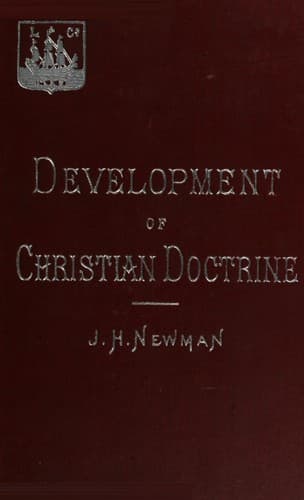
An Essay on the Development of Christian DoctrineNewman, John Henry
Religion
An Essay on the Development of Christian Doctrine
Newman, John Henry
Catholic Church -- Doctrines; Dogma, Development of
Lutheranism has by this time become in most places almost simple heresy
or infidelity; it has terminated, if it has even yet reached its limit,
in a denial both of the Canon and the Creed, nay, of many principles of
morals. Accordingly the question arises, whether these conclusions are
in fairness to be connected with its original teaching or are a
corruption. And it is no little aid towards its resolution to find that
Luther himself at one time rejected the Apocalypse, called the Epistle
of St. James "straminea," condemned the word "Trinity," fell into a kind
of Eutychianism in his view of the Holy Eucharist, and in a particular
case sanctioned bigamy. Calvinism, again, in various distinct countries,
has become Socinianism, and Calvin himself seems to have denied our
Lord's Eternal Sonship and ridiculed the Nicene Creed.
Another evidence, then, of the faithfulness of an ultimate development
is its _definite anticipation_ at an early period in the history of the
idea to which it belongs.
SECTION VI.
SIXTH NOTE. CONSERVATIVE ACTION UPON ITS PAST.
As developments which are preceded by definite indications have a fair
presumption in their favour, so those which do but contradict and
reverse the course of doctrine which has been developed before them, and
out of which they spring, are certainly corrupt; for a corruption is a
development in that very stage in which it ceases to illustrate, and
begins to disturb, the acquisitions gained in its previous history.
It is the rule of creation, or rather of the phenomena which it
presents, that life passes on to its termination by a gradual,
imperceptible course of change. There is ever a maximum in earthly
excellence, and the operation of the same causes which made things great
makes them small again. Weakness is but the resulting product of power.
Events move in cycles; all things come round, "the sun ariseth and goeth
down, and hasteth to his place where he arose." Flowers first bloom, and
then fade; fruit ripens and decays. The fermenting process, unless
stopped at the due point, corrupts the liquor which it has created. The
grace of spring, the richness of autumn are but for a moment, and
worldly moralists bid us _Carpe diem_, for we shall have no second
opportunity. Virtue seems to lie in a mean, between vice and vice; and
as it grew out of imperfection, so to grow into enormity. There is a
limit to human knowledge, and both sacred and profane writers witness
that overwisdom is folly. And in the political world states rise and
fall, the instruments of their aggrandizement becoming the weapons of
their destruction. And hence the frequent ethical maxims, such as, "_Ne
quid nimis_," "_Medio tutissimus_," "Vaulting ambition," which seem to
imply that too much of what is good is evil.
Public-domain text, read in full here on John Shaqi.
Reviews
Reviews
No reviews yet
Be the first to share your thoughts on this work.
Elsewhere in the archive
Join the Discussion
Join the discussion
Sign in to leave a comment or review.
Sign InorCreate an account