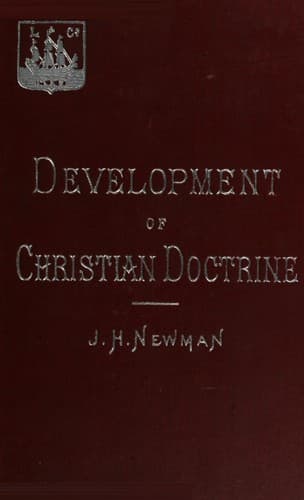
An Essay on the Development of Christian DoctrineNewman, John Henry
Religion
An Essay on the Development of Christian Doctrine
Newman, John Henry
Catholic Church -- Doctrines; Dogma, Development of
So great a paradox of course cannot be maintained as that truth
literally leads to falsehood, or that there can be an excess of virtue;
but the appearance of things and the popular language about them will at
least serve us in obtaining an additional test for the discrimination of
a _bonâ fide_ development of an idea from its corruption.
A true development, then, may be described as one which is conservative
of the course of antecedent developments being really those antecedents
and something besides them: it is an addition which illustrates, not
obscures, corroborates, not corrects, the body of thought from which it
proceeds; and this is its characteristic as contrasted with a
corruption.
2.
For instance, a gradual conversion from a false to a true religion,
plainly, has much of the character of a continuous process, or a
development, in the mind itself, even when the two religions, which are
the limits of its course, are antagonists. Now let it be observed, that
such a change consists in addition and increase chiefly, not in
destruction. "True religion is the summit and perfection of false
religions; it combines in one whatever there is of good and true
separately remaining in each. And in like manner the Catholic Creed is
for the most part the combination of separate truths, which heretics
have divided among themselves, and err in dividing. So that, in matter
of fact, if a religious mind were educated in and sincerely attached to
some form of heathenism or heresy, and then were brought under the light
of truth, it would be drawn off from error into the truth, not by losing
what it had, but by gaining what it had not, not by being unclothed, but
by being 'clothed upon,' 'that mortality may be swallowed up of life.'
That same principle of faith which attaches it at first to the wrong
doctrine would attach it to the truth; and that portion of its original
doctrine, which was to be cast off as absolutely false, would not be
directly rejected, but indirectly, _in_ the reception of the truth which
is its opposite. True conversion is ever of a positive, not a negative
character."[201:1]
Such too is the theory of the Fathers as regards the doctrines fixed by
Councils, as is instanced in the language of St. Leo. "To be seeking for
what has been disclosed, to reconsider what has been finished, to tear
up what has been laid down, what is this but to be unthankful for what
is gained?"[201:2] Vincentius of Lerins, in like manner, speaks of the
development of Christian doctrine, as _profectus fidei non
permutatio_.[201:3] And so as regards the Jewish Law, our Lord said that
He came "not to destroy, but to fulfil."
3.
Public-domain text, read in full here on John Shaqi.
Reviews
Reviews
No reviews yet
Be the first to share your thoughts on this work.
Elsewhere in the archive
Join the Discussion
Join the discussion
Sign in to leave a comment or review.
Sign InorCreate an account