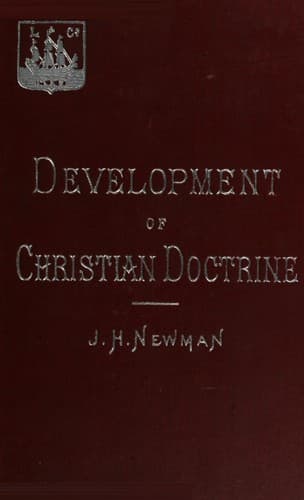
An Essay on the Development of Christian DoctrineNewman, John Henry
Religion
An Essay on the Development of Christian Doctrine
Newman, John Henry
Catholic Church -- Doctrines; Dogma, Development of
Only a heavenly light can give purity to nocturnal and subterraneous
worship. Caves were at that time appropriated to the worship of the
infernal gods. It was but natural that these wild religions should be
connected with magic and its kindred arts; magic has at all times led to
cruelty, and licentiousness would be the inevitable reaction from a
temporary strictness. An extraordinary profession, when men are in a
state of mere nature, makes hypocrites or madmen, and will in no long
time be discarded except by the few. The world of that day associated
together in one company, Isiac, Phrygian, Mithriac, Chaldean, wizard,
astrologer, fortune-teller, itinerant, and, as was not unnatural, Jew.
Magic was professed by the profligate Alexander, and was imputed to the
grave Apollonius. The rites of Mithras came from the Magi of Persia; and
it is obviously difficult to distinguish in principle the ceremonies of
the Syrian Taurobolium from those of the Necyomantia in the Odyssey, or
of Canidia in Horace.
The Theodosian Code calls magic generally a "superstition;" and magic,
orgies, mysteries, and "sabbathizings," were referred to the same
"barbarous" origin. "Magical superstitions," the "rites of the Magi,"
the "promises of the Chaldeans," and the "Mathematici," are familiar to
the readers of Tacitus. The Emperor Otho, an avowed patron of oriental
fashions, took part in the rites of Isis, and consulted the Mathematici.
Vespasian, who also consulted them, is heard of in Egypt as performing
miracles at the suggestion of Serapis. Tiberius, in an edict, classes
together "Egyptian and Jewish rites;" and Tacitus and Suetonius, in
recording it, speak of the two religions together as "_ea
superstitio_."[216:1] Augustus had already associated them together as
superstitions, and as unlawful, and that in contrast to others of a like
foreign origin. "As to foreign rites (_peregrinæ ceremoniæ_)," says
Suetonius, "as he paid more reverence to those which were old and
enjoined, so did he hold the rest in contempt."[216:2] He goes on to say
that, even on the judgment-seat, he had recognized the Eleusinian
priests, into whose mysteries he had been initiated at Athens; "whereas,
when travelling in Egypt, he had refused to see Apis, and had approved
of his grandson Caligula's passing by Judæa without sacrificing at
Jerusalem." Plutarch speaks of magic as connected with the mournful
mysteries of Orpheus and Zoroaster, with the Egyptian and the Phrygian;
and, in his Treatise on Superstition, he puts together in one clause, as
specimens of that disease of mind, "covering oneself with mud, wallowing
in the mire, sabbathizings, fallings on the face, unseemly postures,
foreign adorations."[216:3] Ovid mentions in consecutive verses the
rites of "Adonis lamented by Venus," "The Sabbath of the Syrian Jew,"
and the "Memphitic Temple of Io in her linen dress."[216:4] Juvenal
speaks of the rites, as well as the language and the music, of the
Public-domain text, read in full here on John Shaqi.
Reviews
Reviews
No reviews yet
Be the first to share your thoughts on this work.
Elsewhere in the archive
Join the Discussion
Join the discussion
Sign in to leave a comment or review.
Sign InorCreate an account