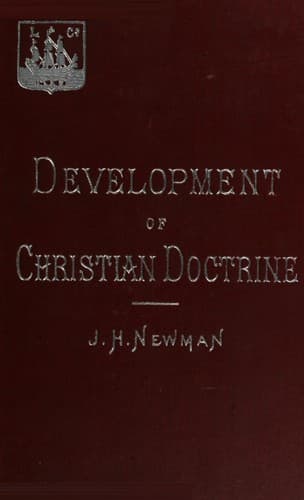
An Essay on the Development of Christian DoctrineNewman, John Henry
Religion
An Essay on the Development of Christian Doctrine
Newman, John Henry
Catholic Church -- Doctrines; Dogma, Development of
Yet, strange as it may appear, there was one title of the Church of a
very different nature from those which have been enumerated,--a title of
honour, which all men agreed to give her,--and one which furnished a
still more simple direction than such epithets of abuse to aid the busy
and the ignorant in finding her, and which was used by the Fathers for
that purpose. It was one which the sects could neither claim for
themselves, nor hinder being enjoyed by its rightful owner, though,
since it was the characteristic designation of the Church in the Creed,
it seemed to surrender the whole controversy between the two parties
engaged in it. Balaam could not keep from blessing the ancient people of
God; and the whole world, heresies inclusive, were irresistibly
constrained to call God's second election by its prophetical title of
the "Catholic" Church. St. Paul tells us that the heretic is "condemned
by himself;" and no clearer witness against the sects of the earlier
centuries was needed by the Church, than their own testimony to this
contrast between her actual position and their own. Sects, say the
Fathers, are called after the name of their founders, or from their
locality, or from their doctrine. So was it from the beginning: "I am of
Paul, and I of Apollos, and I of Cephas;" but it was promised to the
Church that she should have no master upon earth, and that she should
"gather together in one the children of God that were scattered abroad."
Her every-day name, which was understood in the marketplace and used in
the palace, which every chance comer knew, and which state-edicts
recognized, was the "Catholic" Church. This was that very description of
Christianity in those times which we are all along engaged in
determining. And it had been recognized as such from the first; the name
or the fact is put forth by St. Ignatius, St. Justin, St. Clement; by
the Church of Smyrna, St. Irenæus, Rhodon or another, Tertullian,
Origen, St. Cyprian, St. Cornelius; by the Martyrs, Pionius, Sabina, and
Asclepiades; by Lactantius, Eusebius, Adimantius, St. Athanasius, St.
Pacian, St. Optatus, St. Epiphanius, St. Cyril, St. Basil, St. Ambrose,
St. Chrysostom, St. Jerome, St. Augustine, and Facundus. St. Clement
uses it as an argument against the Gnostics, St. Augustine against the
Donatists and Manichees, St. Jerome against the Luciferians, and St.
Pacian against the Novatians.
7.
Public-domain text, read in full here on John Shaqi.
Reviews
Reviews
No reviews yet
Be the first to share your thoughts on this work.
Elsewhere in the archive
Join the Discussion
Join the discussion
Sign in to leave a comment or review.
Sign InorCreate an account